
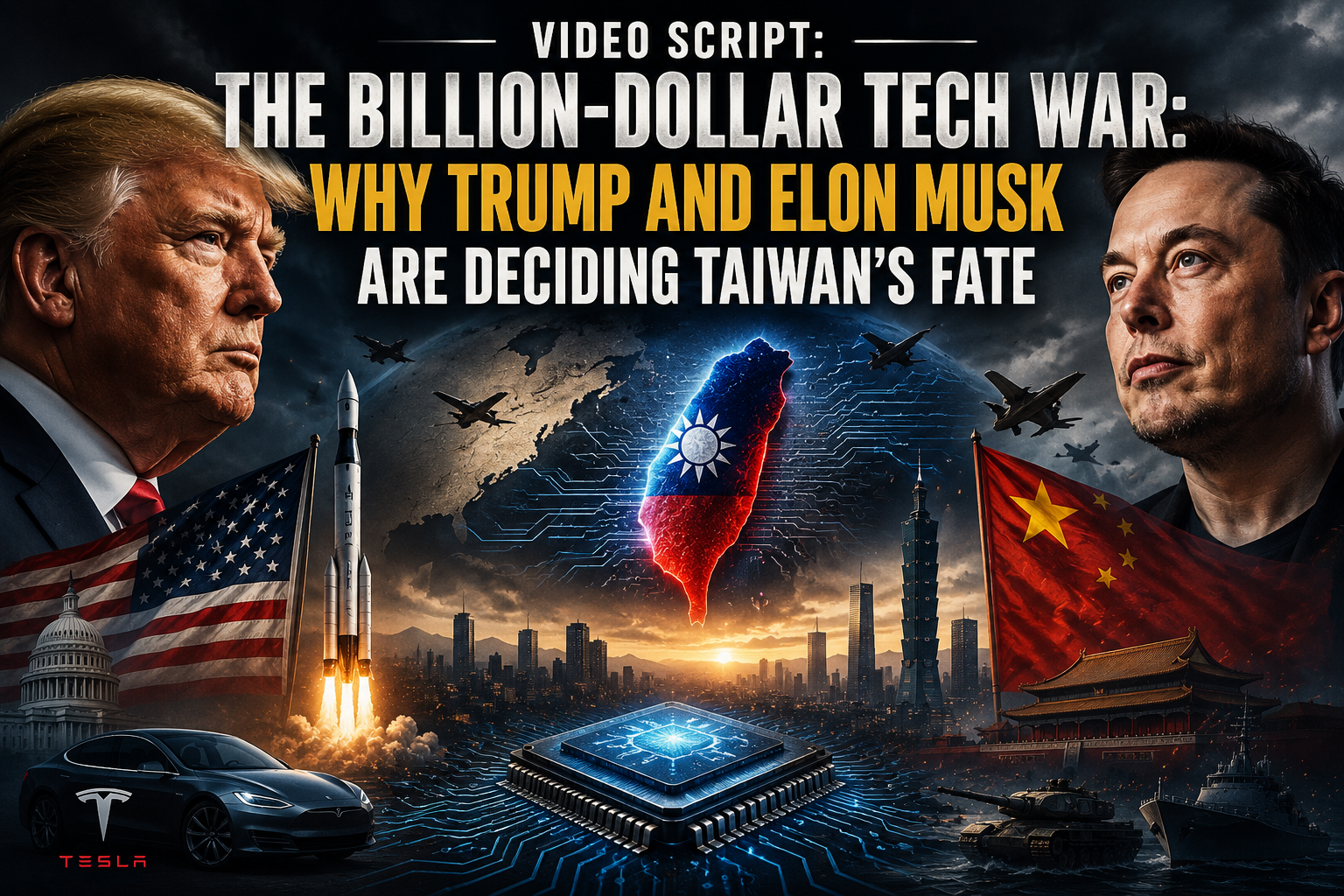
Right now, a quiet but brutal war is being fought over these microchips. Here is the US China Taiwan chip war explained, and how it shapes global power.
[00:00 – 01:30] PART 1: THE HOOK (The Microscopic Superweapon)
[Visual Cue: Open with cinematic, fast-paced cuts of semiconductor manufacturing labs—robotic arms moving with extreme precision under neon blue lights. Cut to satellite footage zooming into Taiwan, then flashing headlines of Donald Trump and Elon Musk.]
Voiceover (VO): In the 20th century, if you wanted to control the world, you needed to control oil pipelines. In 2026, the global chess game has completely changed. If you want to rule the world today, you don’t look for black gold in the desert. You look for a microscopic, hyper-engineered sliver of silicon, no thicker than a human hair, manufactured on a tiny island just 100 miles off the coast of mainland China.
We are talking about semiconductors. The invisible brains running everything from the smartphone in your hand to advanced military fighter jets, and the massive data centers fueling the artificial intelligence revolution.
Right now, a quiet but brutal war is being fought over these chips. On one side, you have Washington trying to choke off Beijing’s technological rise. On the other, you have China fighting for complete self-reliance, with Taiwan trapped right in the crosshairs.
But recently, the stakes just broke the ceiling. The return of Donald Trump to the White House and the unprecedented political rise of the world’s richest man, Elon Musk, have completely rewritten the rules of this conflict. Why is Trump taking a transactional approach to Taiwan? Why is Elon Musk playing a dangerous double game with Beijing? And why does a single company in Taiwan hold the entire global economy hostage?
Let’s break down the real story behind the US-China-Taiwan chip war, and the secret corporate and political maneuvers shaping our future.
[01:31 – 04:00] PART 2: THE SILICON SHIELD (Why Taiwan Rules the World)
[Visual Cue: Display a clear map highlighting the geographic vulnerability of Taiwan relative to mainland China, followed by a motion graphic showing TSMC’s staggering market share.]
VO:
To understand why tensions are boiling over, you first have to understand the terrifying monopoly of one company: TSMC, or Taiwan Semiconductor Manufacturing Company.
Taiwan produces over 60% of the world’s microchips. But here is the real kicker—when it comes to ultra-advanced, hyper-fast processors, the kind under 7 nanometers that power Nvidia’s AI chips or Apple’s iPhones, TSMC manufactures over 90% of them. No other country, not even the United States or China, has been able to successfully clone or replicate these advanced fabrication facilities, known as “fabs.”
Geopoliticians call this dominance Taiwan’s “Silicon Shield.” The logic was simple for decades: Taiwan is so indispensable to the global economy that if China were to invade or blockade the island, the global supply chain would instantly plunge into a dark age. Because a war over Taiwan would wipe out trillions of dollars overnight, the United States has always had a massive incentive to defend the island at all costs. The chips were Taiwan’s insurance policy.
But shields can crack. And under the current political climate, that shield is looking incredibly fragile.
[04:01 – 07:00] PART 3: THE TRUMP FACTOR & THE CHIPS ACT
[Visual Cue: Split-screen showing Donald Trump speaking at a rally on one side, and factory construction in Arizona on the other side. Keep typography bold and fast.]
VO:
Enter Donald Trump. Historically, Washington’s approach to Taiwan was based on strategic ambiguity—a diplomatic promise to protect the island’s democracy. But Trump views global geopolitics through a completely different lens. For him, everything is a business transaction.
Trump has publicly questioned America’s traditional defense commitments, famously stating that Taiwan “stole” the semiconductor business from the US and should pay Washington for protection, much like an insurance premium.
This transactional mindset has fundamentally shifted America’s strategy. Instead of just protecting Taiwan, Washington is aggressively playing hardball to pull the manufacturing out of Taiwan entirely. Through the multi-billion dollar CHIPS Act, the US government is throwing massive subsidies at TSMC and Intel to build cutting-edge factories on American soil, specifically in Arizona.
The goal? If China ever moves on Taiwan, Washington wants to make sure America’s tech infrastructure is already safely insulated inside US borders. It’s a policy of “de-risking,” but for Taiwan, it feels like their ultimate leverage—the Silicon Shield—is being systematically dismantled by their own ally.
[07:01 – 09:30] PART 4: THE ELON MUSK DOUBLE GAME
[Visual Cue: Cut to footage of Elon Musk visiting Tesla’s Gigafactory in Shanghai, shaking hands with Chinese officials, contrasted with his deep integration into the US Department of Defense through SpaceX and Starlink.]
VO:
But there is another wildcard in this equation, an individual who holds massive sway over both Donald Trump and global technology: Elon Musk.
Musk’s role in the US-China-Taiwan triangle is incredibly complex because his business empire is fundamentally split down the middle. On one side, Musk is a vital US national security asset. His company, SpaceX, launches critical military satellites, and Starlink provides the essential satellite internet backbone used by global militaries.
On the other hand, Musk’s crown jewel, Tesla, is deeply dependent on mainland China. Tesla’s Gigafactory in Shanghai is its most productive and profitable manufacturing hub on Earth, producing half of all global Tesla vehicles. Musk relies heavily on Chinese supply chains, battery manufacturers, and the goodwill of the Chinese Communist Party to keep Tesla dominant.
Because of this, Musk has historically taken a very soft, conciliatory stance toward Beijing. He has publicly referred to Taiwan as an “integral part” of China, suggesting a resolution where Taiwan becomes a special administrative zone under Beijing’s control—a stance that directly mirrors China’s own political goals and infuriates leadership in Taipei.
This creates an unprecedented geopolitical conflict of interest. You have the world’s wealthiest individual, who is intimately involved in advising US government efficiency and technology policy, while simultaneously holding massive financial liabilities inside America’s biggest economic rival, China.
[09:31 – 12:00] PART 5: THE FALLOUT (What Happens Next?)
[Visual Cue: Dramatic, slower-paced music. Visualizations of stock market tickers crashing, empty automotive factory lines, and a closing shot of the global map showing trade routes through the South China Sea.]
VO:
So, why is this happening right now? Because the race for global supremacy is no longer about the size of a country’s standing army or nuclear arsenal. It is measured by the nanometer precision of its computing power.
The explosion of Generative AI has turned semiconductors into the ultimate weapon. The country that controls the factories printing Nvidia’s GPUs or future quantum processors will dictate the economic, military, and corporate future of the human race.
China is currently spending hundreds of billions of dollars to achieve complete chip self-sufficiency, hoarding older “legacy chips” and squeezing global raw materials like Gallium and Germanium. Meanwhile, America is frantically building a domestic semiconductor fortress, relying on tech barons and transaction-heavy politics to redraw the global supply map.
If things boil over in the Taiwan Strait, the ripple effect will hit your wallet hard. Everyday tech prices would skyrocket, car manufacturing lines would freeze globally, and a multi-trillion-dollar Wall Street meltdown would trigger an instant global recession.
The battle for semiconductor supremacy is radically rewriting the rules of international diplomacy. And as Washington builds its walls and Beijing accelerates its push for independence, the entire modern world remains profoundly dependent on a fragile peace over a tiny island of silicon.

Faiz Malik is the founder of Moneydigitals, where he simplifies stock market, crypto, and global investing for beginners. His mission is to help people build wealth smartly with practical insights and real-world strategies.