
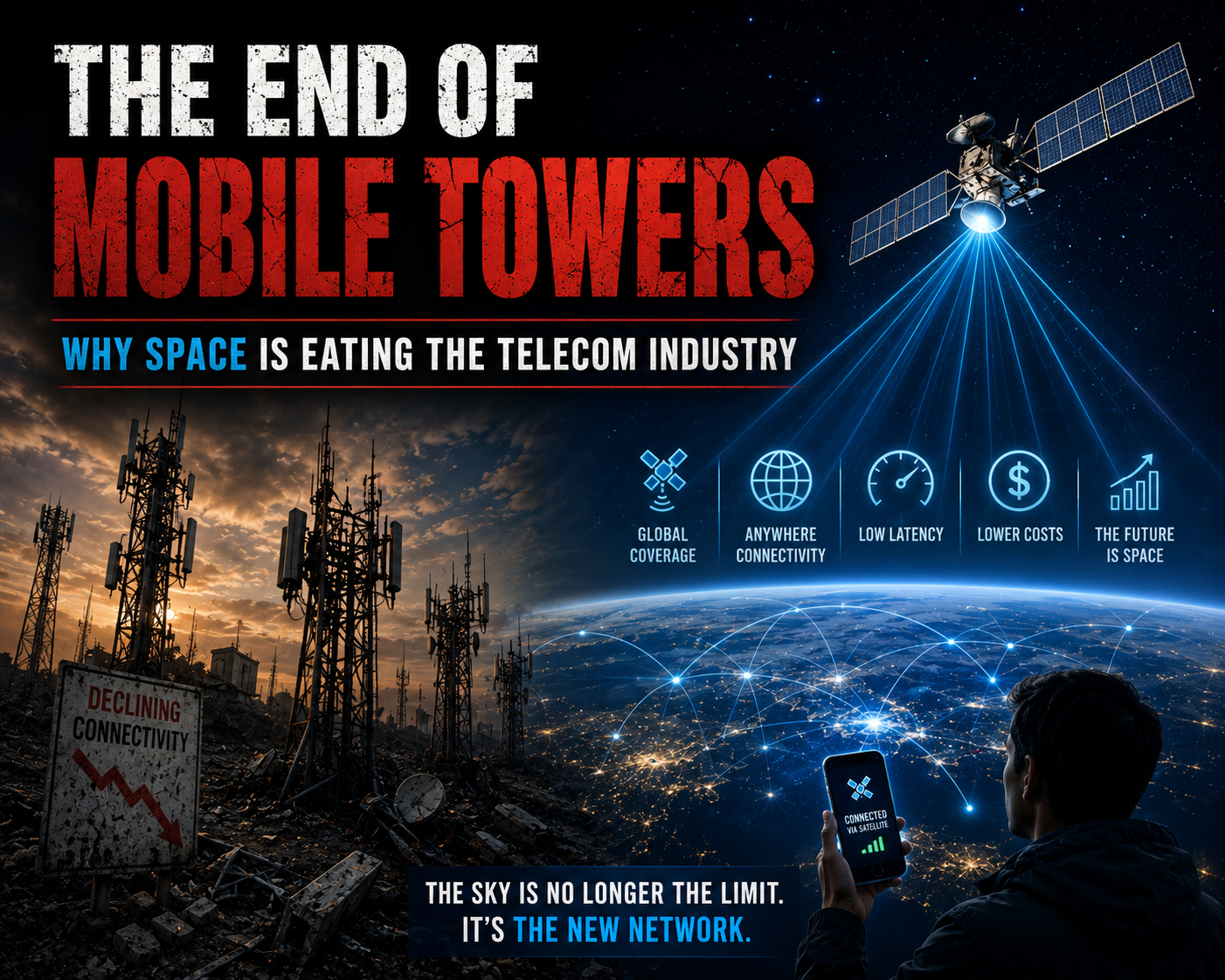
The End of Mobile Towers: Why Space Is Eating the Telecom Industry
Look around your city or highway, and you will see them everywhere. Giant, ugly steel mobile towers sticking out from the landscape. For thirty years, we just accepted them as a permanent part of life. But right now, a massive engineering shift is introducing the satellite-to-phone direct link, and it is about to make those multi-million dollar steel towers on the ground completely useless.
But right now, a massive engineering shift is quietly happening above our heads, and it is about to make those multi-million dollar steel towers on the ground completely useless.
We are moving into a world of direct-to-cell satellite tech. To put it casually: tech companies are taking cell towers off the earth and shooting them into space. Your regular smartphone—the exact one you are holding right now—is about to stop talking to local towers and start connecting straight to satellites orbiting miles above the earth. No special equipment, no bulky antennas, and absolutely no dead zones.
What Actually Broke the System?
For a long time, satellite phones were a rich man’s toy. They were heavy, had massive antennas, and cost a fortune per minute. This happened because old satellites sat in what is called Geostationary Orbit, about 36,000 kilometers away. Beaming a tiny signal from a pocket phone that far into space was just impossible due to basic physics.
Everything changed when companies started dumping fleets of smaller satellites into Low-Earth Orbit, which is only a few hundred kilometers up. Suddenly, the distance shrank. Over the last couple of years, firms like SpaceX and AST SpaceMobile solved the puzzle. They built massive, unfolding panels in space that act exactly like cell towers. These arrays are so sensitive they can catch the faint 4G or 5G signals coming from a normal iPhone or Android device.
Think about the scale of this. Telecom operators like AT&T and T-Mobile aren’t fighting this space race; they are throwing billions of dollars at it. Why? Because putting up physical towers in remote areas, digging trenches for cables, and paying for security is a financial nightmare. Connecting their existing users straight to space gives them 100% network coverage overnight without building a single thing on the ground.
The Money Shift on Wall Street
When a massive tech shift like this happens, the stock market goes through a brutal shakeup. Investors are starting to draw a clear line between the winners and the losers of this space war.
On one side, you have the satellite infrastructure companies that are hitting the jackpot. Their stock charts are buzzing because they are signing exclusive, massive commercial deals with global telecom giants.
On the flip side, the big losers are the traditional tower companies. For decades, buying stocks in companies that owned physical cell towers was considered the safest bet on Wall Street. They collected easy rent from mobile carriers who had no other choice but to use their metal poles. Now, big investment funds are realizing that maintaining thousands of rusty ground towers looks incredibly dumb and expensive compared to a clean, scalable fleet of satellites in orbit. The money is moving fast.
A Hidden Geopolitical Mess
This isn’t just about tech billionaires fixing dropped calls for hikers. It is a messy, high-stakes political battleground between world superpowers. The country that controls the best satellite-to-phone network basically controls the entire globe’s backup communication lines.
Right now, the US is leading because of private American space firms. But China is not sitting around watching. Beijing knows how dangerous it is to rely on American orbital networks, so they have launched their own mega-satellite projects like “Guowang” to blanket the skies with their own tech. They want complete control over their data, and they want to sell that network to their allies across Asia and Africa.
There is also a massive issue regarding control and censorship. Usually, if a government wants to block the internet or stop a protest, they just order local telecom companies to pull the plug on the local cell towers. But how do you stop a satellite that is flying over your country in international space? If a satellite can beam unfiltered data straight to a citizen’s handset from orbit, shutting down information becomes almost impossible. It completely breaks the concept of government-controlled digital borders.
The Realistic Hurdles
Of course, this isn’t a perfect fairy tale. The biggest problem right now is that Low-Earth Orbit is turning into a cosmic traffic jam. To make this work seamlessly everywhere, companies need to launch tens of thousands of these small satellites. Space debris is a real, terrifying hazard. One accidental collision up there can create millions of tiny, high-speed shards that could destroy other crucial satellites.
There is also a massive fight over radio frequencies. Satellites have to use the exact same cellular bands that ground networks use. If they don’t sync them perfectly, the space signals will jam the remaining ground signals, causing massive chaos and dropped calls everywhere. Fixing this requires intense, slow diplomatic arguments through international agencies.
The Big Picture
Even with the technical roadblocks, the direction we are moving in is obvious. The physical mobile tower is old technology trying to solve a modern problem. Within the next few years, ground towers will probably only exist in crowded cities to handle heavy local data traffic. The rest of the planet will just look up at the sky for a signal.
This shift is the ultimate equalizer. It means a scientist in the freezing Arctic, a traveler lost in the Amazon rainforest, and a kid in a remote village with zero local development will all have access to the exact same high-speed internet. By cutting the invisible wire that holds our phones to the ground, we are building a truly borderless world.

Faiz Malik is the founder of Moneydigitals, where he simplifies stock market, crypto, and global investing for beginners. His mission is to help people build wealth smartly with practical insights and real-world strategies.