
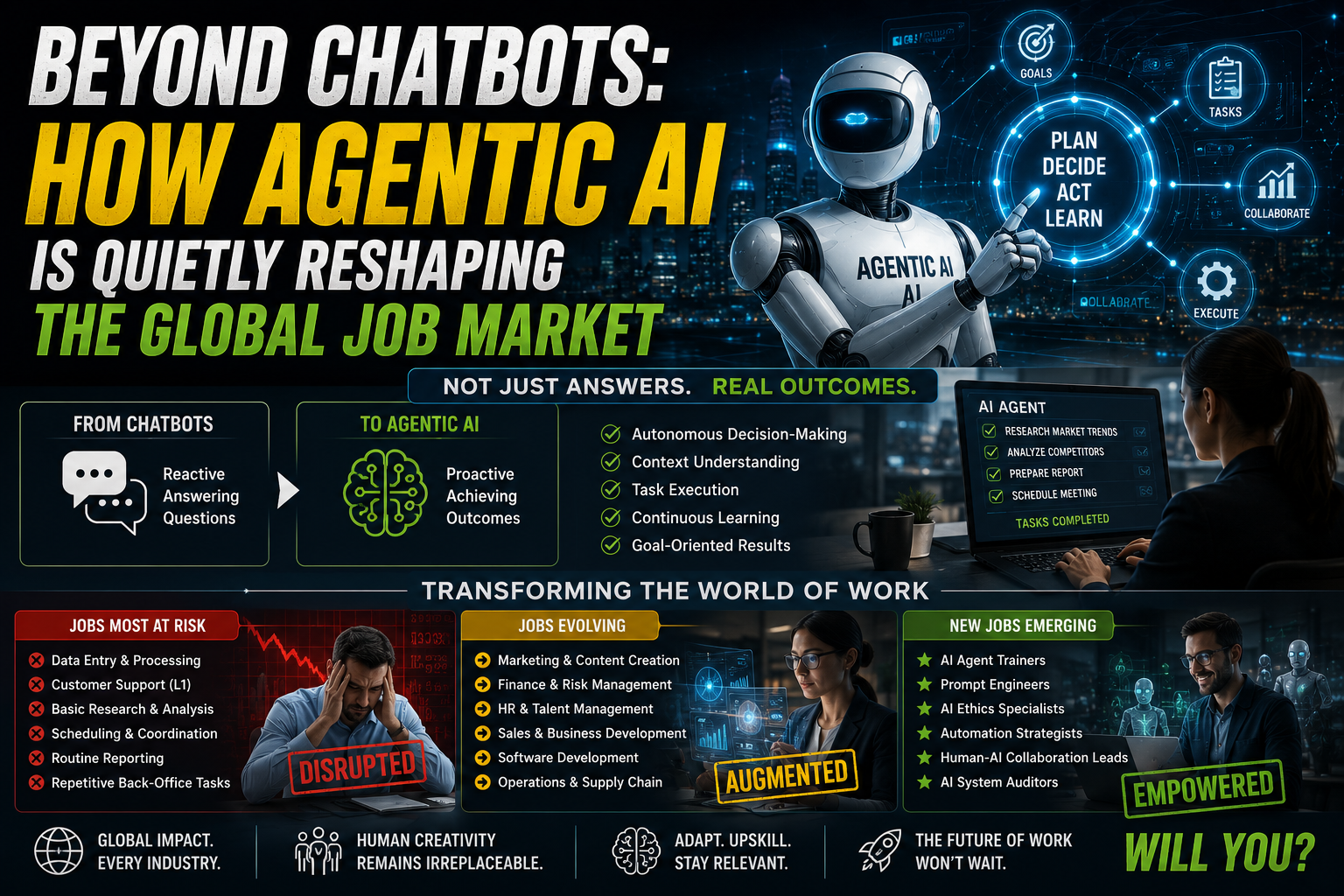
Beyond Chatbots: How Agentic AI is Quietly Reshaping the Global Job Market
The Agentic AI Future of Jobs is rapidly evolving, changing how professionals interact with technology in the workplace. The era of passive, prompt-based AI assistants is officially coming to an end. Enter the age of Agentic AI—autonomous digital entities that don’t just answer questions, but actually execute entire multi-step corporate jobs without needing constant human hand-holding.
This rapid transition from simple chat assistants to self-governing “AI Agents” is structurally shifting the foundation of enterprise operations and workforce dynamics. Recent market projections from Capgemini and Gartner reveal a striking reality: by the end of this year, over 40% of all enterprise software applications will feature task-specific autonomous AI agents, up from a microscopic 5% just a couple of years ago.
This isn’t a future problem on a corporate roadmap anymore; it is happening right here, right now. As companies shift from testing pilots to scaling these digital workforces, the conversation around the future of jobs is getting much more complicated, demanding, and raw.
What Exactly is Agentic AI? (Cutting Through the Hype)
To understand how this impacts your career, you first need to understand how these agents function compared to old-school automation. Traditional automation, like Robotic Process Automation (RPA), is rigid. It follows strict, pre-written rules: “If X happens, do Y.” If anything changes even by a millimeter, the system crashes.
An AI Agent, however, is built with reasoning capabilities, persistent memory, and tool integration. You don’t give it step-by-step instructions; you simply give it an ultimate goal. For example, instead of a human spent hours pulling data, an AI Agent can independently log into an ERP system, analyze real-time sales anomalies, cross-reference inventory data across warehouses, coordinate stakeholders via automated emails, reroute supply shipments during a disruption, and file compliance reports—all while adapting to real-time changes within its predefined guardrails.
It acts less like a software tool and more like an independent, digital co-worker. According to tech analysts, this next layer of operational intelligence is on track to unlock up to $450 billion in economic value across global supply chains, financial services, and customer operations.
The Great Corporate Flattening: Who is Losing Their Jobs?
Let’s skip the diplomatic PR corporate speak and address the absolute elephant in the room: job displacement. The old narrative that “AI won’t replace you, but a human using AI will” is starting to look a bit outdated. In highly process-driven, administrative, and repetitive white-collar sectors, AI agents are flat-out replacing functional roles.
The hardest hit segment in corporate organizations is currently middle management. Historically, middle managers existed to pass information up and down the corporate ladder, coordinate tasks between teams, and monitor worker productivity. Today, multi-agent orchestration frameworks handle this coordination automatically. Because these intelligent systems pass context, track project metrics, and assign sub-tasks seamlessly, Gartner reports that roughly 20% of enterprises are using AI to flatten their organizational structures, cutting out more than half of traditional middle management positions.
Similarly, entry-level roles in customer support operations, basic financial reporting, data validation, and legal document review are facing immediate cooling. A company that previously needed a team of ten junior backend operations associates can now deploy a network of specialized AI agents that complete the exact same processes in a fraction of the time with near-zero error rates.
The Shift in Software Engineering: From Coding to System Architecture
Even the tech sector itself isn’t immune to this shift. The role of the software developer is undergoing an intense, fundamental rewiring. The market value of a junior developer who purely writes standard code blocks or basic functions is dropping rapidly. AI coding agents can generate, debug, and optimize standard code infrastructure in seconds.
However, this hasn’t killed software engineering jobs; it has simply raised the bar. The modern tech market is experiencing an explosive surge in demand for AI Systems Orchestrators. Top-tier engineers are no longer spending their days writing manual code; instead, they are designing the complex guardrails, safety protocols, and memory loops that govern teams of autonomous AI agents.
According to wage data from global talent platforms, tech professionals who possess advanced skills in multi-agent orchestration frameworks, ethical model alignment, and operational observability are commanding an astounding 56% wage premium compared to traditional software engineers. The jobs aren’t completely disappearing, but they are turning into high-level oversight roles.
The Rise of the Human-AI Hybrid Workforce
Despite the widespread fear of absolute automated unemployment, the actual corporate reality playing out isn’t an entirely empty office building run by server racks. Instead, we are seeing the emergence of the Human-AI Hybrid Team.
In progressive enterprises, employees are stepping into the shoes of “Managers of Digital Workers.” A single human professional can now scale their personal output fivefold by managing an array of specialized AI agents.
In Logistics, a supply chain manager uses an agent to automatically handle route optimization and last-mile disruptions, intervening only when the agent flags a high-priority exception.
In Digital Marketing, a content strategist manages agents that handle data scraping, basic copy generation, and SEO formatting, allowing the human to focus purely on high-level brand strategy and psychological positioning.
The workers who are thriving in this new environment are those who view AI as a leverage tool rather than a threat. Businesses are actively shifting their hiring metrics away from routine technical execution and moving heavily toward human-centric soft skills. Because generative tools can occasionally hallucinate, skills like critical thinking, complex problem solving, and strict verification protocols have become the ultimate premium assets.
The Verdict: How to Protect Your Career
The rise of Agentic AI proves that leaning purely on routine, repetitive technical skills is a dangerous career strategy. If your daily work tasks can be easily predicted, structured into a flowchart, or completed by looking at a fixed set of past examples, an AI agent will eventually be able to do it faster and cheaper.
To stay entirely irreplaceable, your career moves need to focus on things these autonomous models cannot replicate: deep contextual empathy, high-stakes negotiation, creative business model innovation, and the technical capability to manage the AI infrastructure itself. The digital workforce is officially checking in—and the only way to stay relevant is to stop acting like a machine and start mastering the systems that run them.
Disclaimer: This technological economic report is compiled strictly for educational and informational analysis. All enterprise market statistics, wage premiums, adoption trends, and organizational percentage data reflect verified global enterprise observations up to May 20, 2026. As regulatory bodies roll out new compliance frameworks regarding autonomous digital labor, workforce dynamics may adjust accordingly.

Faiz Malik is the founder of Moneydigitals, where he simplifies stock market, crypto, and global investing for beginners. His mission is to help people build wealth smartly with practical insights and real-world strategies.