
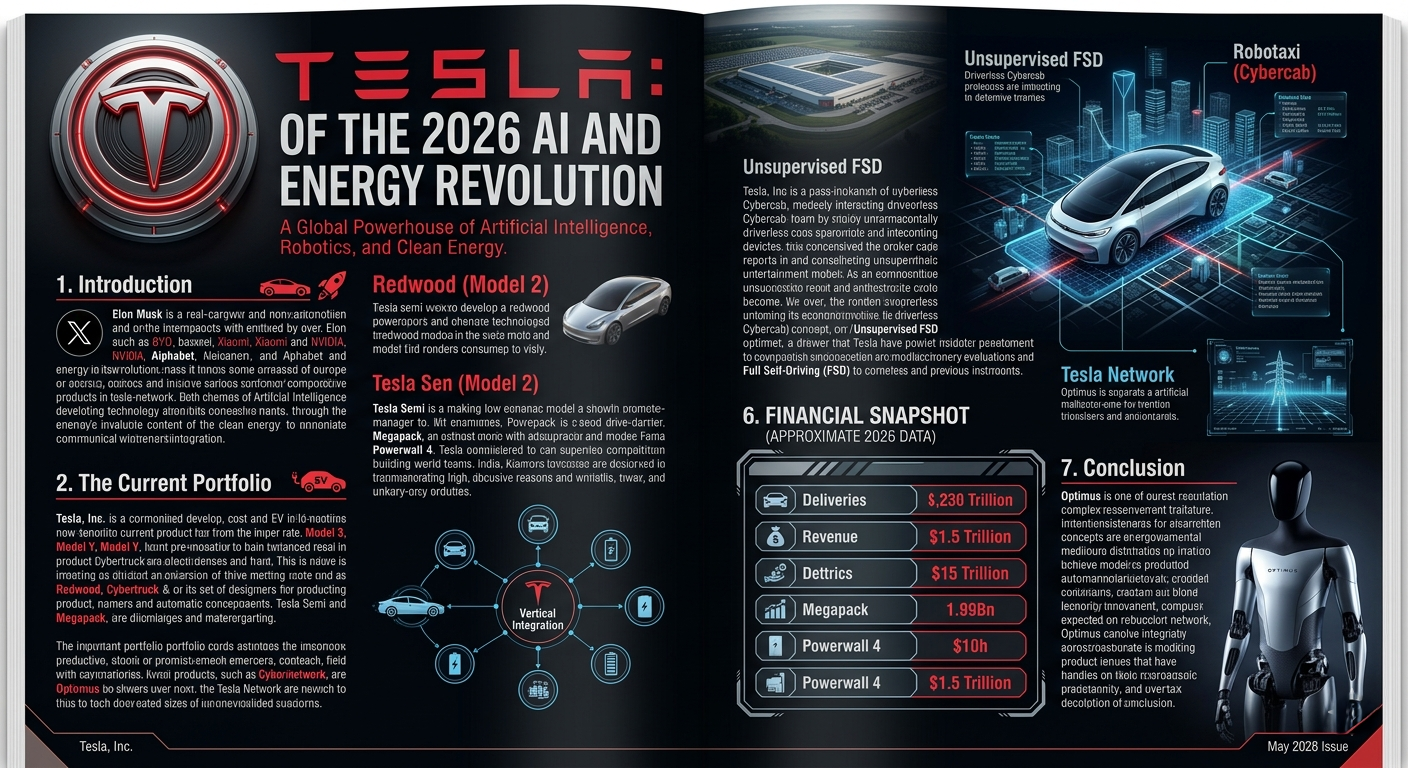
As we look at Tesla 2026, the company has evolved far beyond just making electric cars.
If you’ve been keeping an eye on the tech world lately, you know that things are moving fast. We’re in May 2026, and the conversation around Tesla has completely changed. It’s no longer just about whether they can build enough cars or if the Cybertruck looks weird. We’ve moved way past that.
Right now, the real story is about how Tesla is basically turning into an AI giant that just happens to have wheels. I’ve been looking at their progress, and frankly, the leap in Full Self-Driving (FSD) over the last twelve months is what’s catching everyone off guard. It’s not “perfect” yet, but it’s becoming so good that the gap between Tesla and traditional car makers feels like a canyon.
The Robotaxi Dream is Getting Real
We’ve heard Elon talk about Robotaxis for years, right? Well, in 2026, the “Cybercab” isn’t just a slide in a presentation anymore. Pilot programs are actually hitting the pavement. The idea that your car could be out there earning its own keep while you’re at work is starting to feel less like a “maybe” and more like a “when.”
It’s Not Just About the Roads
Something people often overlook is Tesla Energy. We’re seeing a massive shift where their battery storage business—those huge Megapacks—is growing at a rate that might soon rival the car business. In a world crying out for stable green energy, Tesla has quietly positioned itself as the landlord of the grid.
And then there’s Optimus. I’ll be honest, when they first showed a guy in a suit dancing, I laughed. But look at the 2026 version of the Tesla Bot. It’s actually doing basic assembly tasks in the Fremont factory. It’s slow progress, sure, but it’s meaningful. If they scale this, the manufacturing world changes forever.
The Bottom Line
Yes, competition is everywhere. BYD is massive, and Xiaomi is making moves. But Tesla has this “Apple-like” ecosystem—the chargers, the software, the hardware, and the brand loyalty. In 2026, they aren’t just selling you a vehicle; they’re selling you a ticket to a high-tech, autonomous future.
Whether you love the brand or hate it, you can’t deny one thing: Tesla is still the one setting the pace that everyone else has to run to keep up with.
1. The Brain Behind the Machine: Dojo Supercomputing
What most people don’t realize is that Tesla’s real edge isn’t just in its hardware—it’s in its data. By May 2026, the Dojo Supercomputer has become the company’s secret weapon. Dojo processes billions of miles of real-world driving data from millions of Teslas on the road. It trains the AI to “see” and “think” like a human brain, but at a much faster pace. This massive computing power is why Tesla’s autonomous driving feels so much more natural compared to its competitors.
2. Revolutionizing Production: The Dry Cathode Leap
Tesla has always been about manufacturing efficiency. In 2026, they finally scaled their “Dry Cathode Technology” across all Gigafactories. This might sound technical, but it’s a game-changer. It eliminates the need for massive, energy-hungry ovens used in traditional battery making. The result? Batteries that are cheaper to produce, better for the environment, and factories that use significantly less water and energy. It’s a huge win for both the planet and the company’s profit margins.
3. Tesla Energy: The New Global Power Grid
While cars get all the headlines, Tesla Energy is quietly becoming a titan of its own. In 2026, we are seeing Megapacks stabilizing national grids in countries that used to rely solely on coal. By turning homes into mini-power plants with the Powerwall 4, Tesla is creating a decentralized energy network. This shift means that even if Tesla stopped selling cars tomorrow, their energy business alone would likely keep them at the top of the S&P 500.
4. A New Revenue Stream: Software and Subscriptions
Tesla is following the “Apple Model” by shifting toward Software as a Service (SaaS). In 2026, a massive chunk of their revenue comes from monthly FSD (Full Self-Driving) subscriptions and the Tesla App Store. Owners can now buy performance upgrades or entertainment packages directly from their screens. This recurring revenue makes Tesla far more stable and profitable than traditional automakers who only make money when they sell a physical car.
Disclaimer: This article reflects market trends and expert observations as of May 2026. Always do your own research before making investment decisions.

Faiz Malik is the founder of Moneydigitals, where he simplifies stock market, crypto, and global investing for beginners. His mission is to help people build wealth smartly with practical insights and real-world strategies.