
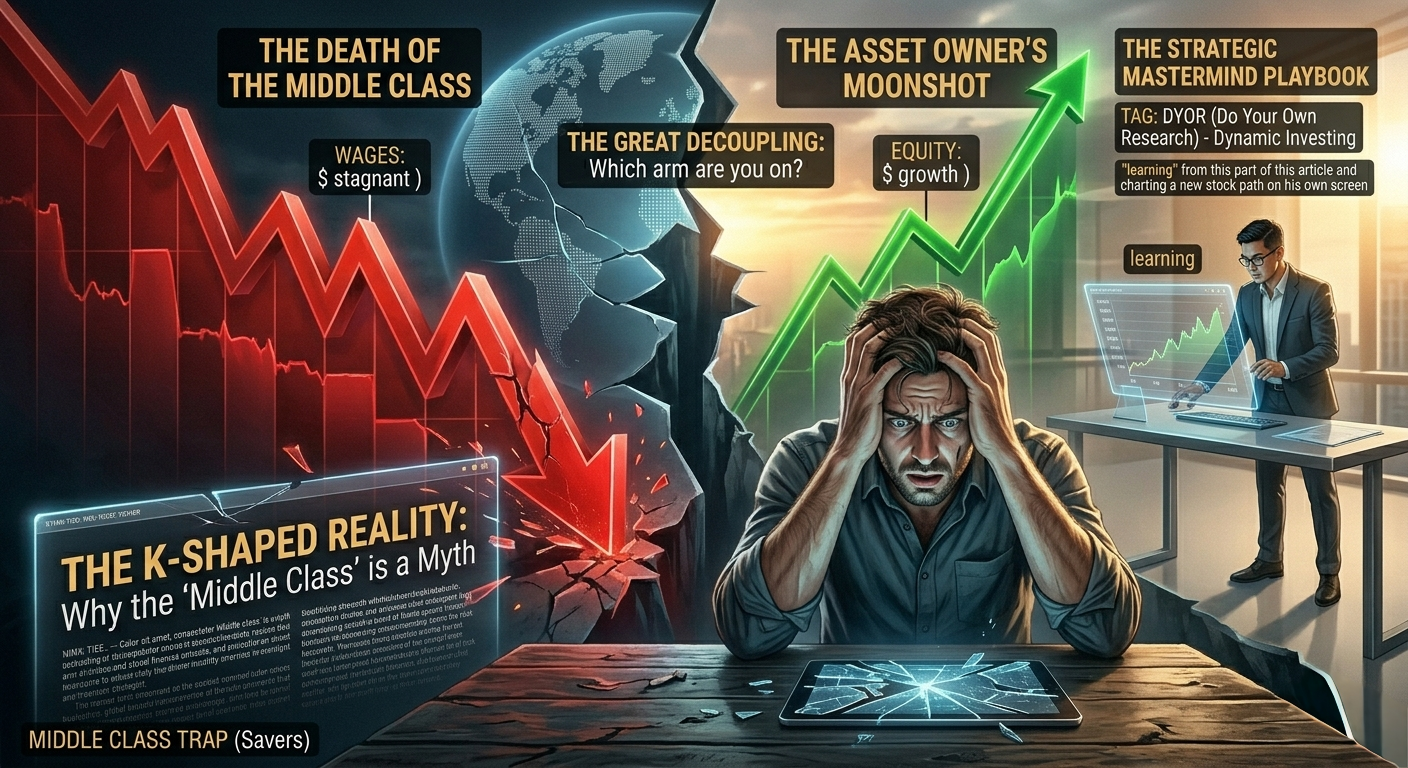
The Death of the Middle Class: 5 Brutal Truths of the K-Shaped Economy 2026
In the rapidly shifting financial landscape, the K-Shaped Economy 2026 has become a harsh reality for the global middle class. Let’s be honest for a second: If you’re still following the financial advice your parents gave you—save 10%, buy a house, and wait for retirement—you’re basically walking into a trap. The rules have changed, and the “comfortable middle” is being hollowed out.
In 2026, the economy isn’t moving up or down in a straight line anymore. It has turned into a “K.” What does that mean? It means one arm of the ‘K’ is shooting toward the moon—this arm is made of asset owners, AI masters, and the tech-elite. Meanwhile, the other arm is crashing hard, consisting of traditional employees, savers, and the 9-to-5 crowd. The middle? It’s disappearing. If you don’t pick a side soon, the K-Shaped Economy 2026 will pick one for you.
1. The Great Decoupling: Why Wages are Losing to Assets
Here is the hard truth that most news channels won’t tell you: Wages are no longer linked to productivity. You can work 80 hours a week, but inflation and the “digital tax” on life will eat your paycheck before it even hits your bank account. The system is designed to reward ownership over effort.
In the K-Shaped Economy 2026, wealth is built through Equity, not Activity. The people getting rich aren’t working harder; they are owning things that grow while they sleep—stocks, real estate, and intellectual property. If you are selling your time for money, you are on the downward arm of the ‘K’. To get on the upward arm, you have to transition from a “Consumer” to an “Owner.”
- The Reality of K-Shaped Economy 2026: Understanding the divide.
- Asset vs. Wages: Why owning assets is the only way to survive.
- The Global Impact: How geopolitical shocks are shifting wealth.
- The Dying Middle Class: Analyzing the gap between the rich and the poor.
- Strategic Survival: How to position yourself on the upward arm of the ‘K’.
2. The Invisible Inflation: The True Price of Quality Life
Government reports might tell you inflation is “under control,” but look at your real-world bills. The cost of basic survival—mass-produced food, cheap energy, and basic rent—is being kept manageable to prevent unrest. However, the cost of a Quality Life (real education, private healthcare, and prime assets) is exploding beyond reach.
This is how the K-Shaped Economy 2026 hides its teeth. It makes the “basics” cheap so people don’t revolt, but it makes “wealth-building assets” incredibly expensive. This is why the stock market keeps hitting all-time highs while the average person feels broke. The market isn’t a reflection of the economy anymore; it’s a reflection of where the top 10% are protecting their purchasing power.
3. The Geopolitical Premium: Volatility as a Wealth Transfer Tool
We live in an era of constant “shocks”—whether it’s the Strait of Hormuz, AI-chip trade wars, or energy crises. Most people see these events on the news and react with fear. They sell their portfolios and hide in cash. That is exactly what the top arm of the ‘K’ wants you to do.
In the K-Shaped Economy 2026, smart money uses volatility to buy the dip. Wealth doesn’t just vanish during a crisis; it simply changes hands. When the “Military-Industrial Complex” stocks rise during a conflict, or tech stocks surge during a labor crisis, the gap widens. Your job is to be the hand that receives the wealth, not the one giving it away in a panic sell.
4. The Skill Gap: Why “Hard Work” is Not Enough
The downward arm of the K-shape is populated by people with “linear skills”—tasks that can be mapped, automated, and eventually performed by AI for near-zero cost. If your job involves following a set of instructions, you are at risk.
The upward arm requires “Asymmetric Skills.” These are skills where the output is 100x the input. Examples include high-level strategy, deep-human networking, and complex decision-making under pressure. In 2026, the market doesn’t pay you for how hard you work; it pays you for how difficult you are to replace.
5. The Sovereign Strategy: How to Survive the ‘K’
I’m not here to scare you; I’m here to wake you up. To stay on the upper arm of the K-Shaped Economy 2026, you need to upgrade your mental software. You cannot solve today’s problems with yesterday’s mindset.
- Ditch the “Savings” Mindset: Cash is a melting ice cube. In 2026, savers are losers. Only “Deployers” of capital—those who move cash into productive assets—will survive the devaluation.
- Focus on Distribution: Whether it’s a website, a newsletter, or a niche community, own the channel through which you reach people. Don’t be a digital sharecropper on someone else’s land.
- Own the Infrastructure: Don’t just buy the product; buy the company that makes the infrastructure for the future. Be the landlord of the digital and physical age.
The “Middle Class” was a 20th-century experiment that is officially over. The world is splitting into those who own the future and those who are owned by it. It sounds harsh because it is. But once you accept the reality of the K-Shaped Economy 2026, you can finally start playing the game to win. The divide is here—which side of the ‘K’ will you be on?

Faiz Malik is the founder of Moneydigitals, where he simplifies stock market, crypto, and global investing for beginners. His mission is to help people build wealth smartly with practical insights and real-world strategies.