
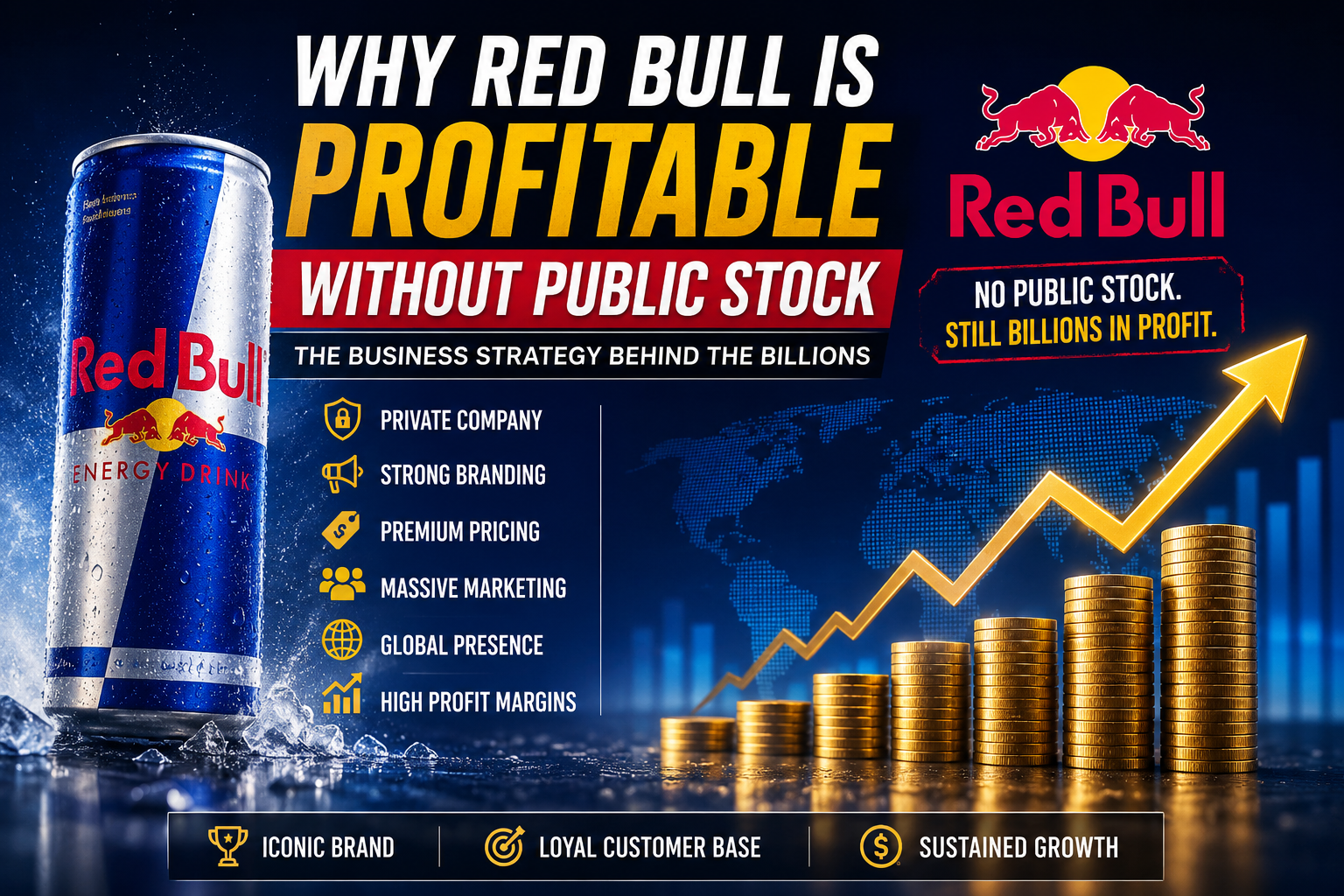
Why Red Bull Is Profitable Without Public Stock is one of the most searched business questions online today.
Among the world’s most recognized energy drink brands, Red Bull stands at the very top. From college students and gamers to athletes and Formula 1 fans, the brand has become part of modern youth culture. But one question often appears online: “Why does Red Bull’s stock always stay in the red, yet the company keeps making huge profits?”
The truth is more interesting than most people realize.
Many people assume that Red Bull is a publicly traded company whose shares constantly rise and fall in the stock market. In reality, Red Bull does not have a public stock at all. The company is privately owned, which means ordinary investors cannot buy Red Bull shares on stock trading apps or exchanges. That is why many discussions about “Red Bull stock being red” are based on confusion or misinformation. (companieshistory.com)
But the real story is not about a falling stock price. The real story is about how a private company built one of the most profitable beverage empires in the world without depending on public investors.
The Beginning of Red Bull
The Red Bull story started in the 1980s when Austrian businessman Dietrich Mateschitz traveled to Thailand. During his trip, he discovered a local energy drink called “Krating Daeng,” which was popular among truck drivers and workers who needed long-lasting energy.
Mateschitz saw huge international potential in the product. He partnered with Thai businessman Chaleo Yoovidhya and redesigned the drink for Western markets. In 1987, Red Bull officially launched.
At first, many consumers were unsure about it. The taste was unusual, and the price was higher than many other drinks on the market. But Red Bull was never just trying to sell a beverage. It was trying to sell an identity.
That decision changed everything.
Today, Red Bull is more than an energy drink company. It is a global lifestyle brand connected with speed, adventure, gaming, motorsports, esports, music festivals, and extreme sports.
Why Isn’t Red Bull on the Stock Market?
Most large companies eventually enter the stock market because public listing allows them to raise money from investors. But Red Bull chose a completely different path.
The company remains privately controlled mainly by the Yoovidhya family and the Mateschitz family. (companieshistory.com)
So why would a giant company avoid the stock market?
The answer is control.
Public companies face constant pressure from shareholders. Every quarter, investors expect higher profits and better growth numbers. If results disappoint, the stock price drops immediately. This creates pressure to focus on short-term gains.
Red Bull wanted freedom instead.
By staying private, the company could make bold long-term decisions without worrying about daily market reactions. This gave Red Bull the flexibility to spend heavily on branding, sports sponsorships, and global marketing strategies that might have looked risky to public investors. (bitget.com)
Where Does the “Stock in Red” Confusion Come From?
A lot of people search for “Red Bull stock” online and find unofficial valuation charts or speculative financial pages. Many mistakenly believe these represent actual public stock prices.
But Red Bull has no official stock ticker symbol because it is not publicly traded. (bitget.com)
Another reason for the confusion is that people compare Red Bull with public beverage companies like Monster Beverage or Celsius Holdings. Those companies have stocks that move up and down daily, so people assume Red Bull works the same way.
It does not.
Red Bull’s business operates differently because its success is measured through brand power, global sales, and long-term dominance rather than stock market performance.
How Does Red Bull Make So Much Profit?
This is where Red Bull becomes fascinating from a business perspective.
The company does not simply sell drinks.
It sells emotion.
Think about Red Bull advertisements. Unlike traditional beverage companies that focus mainly on taste or refreshment, Red Bull markets adrenaline, energy, focus, speed, ambition, and excitement.
When someone drinks Red Bull, they are not just consuming a liquid. They are buying into a mindset.
That psychological connection is one of the company’s biggest strengths.
Red Bull spends enormous amounts of money on marketing every year. The company sponsors athletes, owns sports teams, organizes extreme events, and invests heavily in entertainment.
One of the best examples is Formula 1. Red Bull Racing has become one of the most successful teams in modern Formula 1 history.
At first glance, these sponsorships look incredibly expensive. But for Red Bull, they function like a giant marketing engine.
When millions of viewers watch Red Bull cars winning races or athletes performing impossible stunts, the brand becomes associated with performance, power, and confidence.
That emotional branding later translates into product sales.
Red Bull Sells a Premium Image
Another major reason behind Red Bull’s profitability is pricing strategy.
Many companies compete by lowering prices to attract more customers. Red Bull did the opposite. The company positioned itself as a premium product from the very beginning.
Even though other energy drinks are often cheaper, people still choose Red Bull because the brand feels exclusive and powerful.
Consumers are not only paying for flavor. They are paying for the image attached to the product.
This creates massive profit margins.
The actual manufacturing cost of a single can is far lower than its retail selling price. But because the brand value is so strong, customers willingly pay more.
That is the power of branding.
The Business Model That Changed the Beverage Industry
Red Bull also transformed itself into a media and entertainment company.
Today, the brand owns media production teams, YouTube channels, sporting events, esports tournaments, and content platforms watched by millions of people worldwide.
This strategy is extremely smart.
Most companies constantly pay television networks or social media platforms for advertising space. Red Bull, however, creates content that people voluntarily watch and share.
Instead of interrupting entertainment with ads, Red Bull became the entertainment itself.
That approach dramatically strengthened customer loyalty.
Why Red Bull’s Strategy Works So Well
There are several reasons why the company continues to dominate:
1. Strong Brand Identity
Red Bull knows exactly what it represents. Everything connected to the company reflects energy, adventure, and high performance.
2. Smart Marketing
Instead of traditional advertising alone, Red Bull creates unforgettable moments. Whether it is Formula 1 racing or extreme sports jumps, the company stays connected to thrilling experiences.
3. Premium Pricing
Customers associate Red Bull with quality and status, allowing the company to maintain high prices and large profit margins.
4. Private Ownership
Because Red Bull is private, management can focus on long-term growth rather than short-term stock market pressure.
5. Global Reach
The company sells products in almost every major market around the world, giving it enormous international influence.
Could Red Bull Go Public in the Future?
Many investors hope that one day Red Bull will launch an IPO because it would likely become one of the biggest stock market events in the beverage industry.
However, the company has shown no major signs of planning a public listing. (companieshistory.com)
Experts believe the owners prefer maintaining complete control over the business rather than answering to outside shareholders.
Going public would mean opening the company to market pressure, quarterly expectations, and investor influence.
For now, Red Bull appears comfortable staying private.
Business Lessons from Red Bull
Red Bull teaches several important lessons about modern business.
First, successful companies do not just sell products. They sell stories, emotions, and identity.
Second, branding can be more powerful than the product itself. Many people buy Red Bull because of what the brand represents, not simply because of the drink’s taste.
Third, marketing should be viewed as an investment, not just an expense. Red Bull spent years building cultural influence, and today that influence generates billions in revenue.
Finally, not every successful company needs the stock market. If a business has strong cash flow, loyal customers, and a clear vision, it can thrive privately.
Conclusion
So when people say, “Red Bull’s stock is always red,” they are misunderstanding how the company actually works.
The reality is simple: Red Bull has no public stock because it is a private company. (companieshistory.com)
Yet despite staying away from the stock market, the company continues to generate enormous profits because of its brilliant branding, premium pricing strategy, and emotional connection with consumers.
Red Bull does not just sell energy drinks.
It sells a lifestyle.
And that lifestyle has turned the company into one of the most influential and profitable brands in the world.

Faiz Malik is the founder of Moneydigitals, where he simplifies stock market, crypto, and global investing for beginners. His mission is to help people build wealth smartly with practical insights and real-world strategies.