
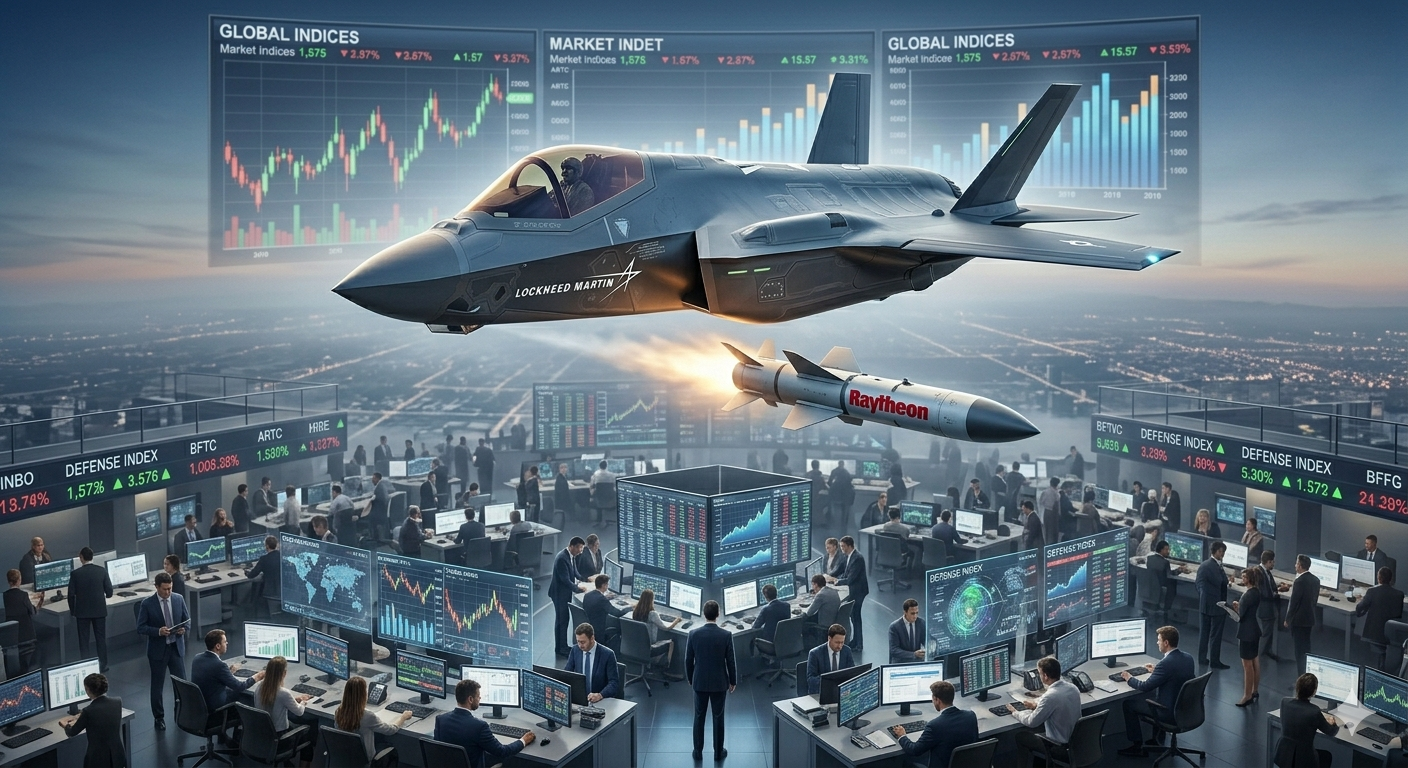
The Silent Giants: How Defense Titans Like Lockheed Martin and Raytheon Rule the Global Market
In the glitzy world of Wall Street, everyone talks about the “Magnificent Seven”—the tech giants like Apple, Nvidia, and Microsoft that drive our daily digital lives. But while the world is distracted by the latest AI chatbots and smartphone releases, a group of much quieter, far more formidable companies is operating in the shadows of the global economy.
These are the Silent Giants. They don’t make consumer apps, and they don’t care about your social media engagement. They build the F-35 fighter jets, the hypersonic missiles, and the satellite arrays that define the boundaries of global power. In May 2026, as geopolitical tensions reach a fever pitch, understanding companies like Lockheed Martin, Raytheon (RTX), and Northrop Grumman isn’t just about military history—it’s about understanding who really holds the strings of the global market.
The Business of Deterrence: Why They Are Market Proof
Why do investors flock to defense stocks the moment a headline about a Middle East conflict breaks? It’s because these companies operate on a business model that is fundamentally different from any other sector. Most businesses have to worry about “demand.” If people stop buying iPhones, Apple’s revenue drops. But in the world of defense, demand is driven by something much more permanent: National Security.
Take Lockheed Martin (LMT), for example. They are the backbone of the U.S. military-industrial complex. When the U.S. government signs a contract for the F-35 program, they aren’t just buying a jet; they are signing up for decades of maintenance, software updates, and pilot training. This creates a “sticky” revenue stream that can last 30 to 40 years. For a shareholder, this is the ultimate peace of mind. While a tech trend might fade in three years, the need for air superiority is eternal.
The Hegemony of Lockheed Martin
Lockheed Martin is effectively the world’s largest “private army” in terms of engineering. Their reach is staggering. From the depths of the ocean with their naval technology to the literal moon with their Orion spacecraft, Lockheed is everywhere.
In 2026, their dominance in Hypersonic Technology has become their new growth engine. As traditional missiles become easier to intercept, the race for weapons that travel at five times the speed of sound has intensified. Lockheed isn’t just a participant in this race; they are setting the pace. This technological moat is so wide that even the richest tech companies in Silicon Valley couldn’t cross it if they tried. It takes decades of specialized classified knowledge to build what they build.
Raytheon (RTX) and the Shield of the Sky
While Lockheed is the sword, Raytheon (RTX) is often the shield. If you’ve been following the news regarding missile defense systems in the Middle East or Eastern Europe, you’ve seen Raytheon’s handiwork. Their Patriot missile systems and the Iron Dome components (developed with partners) are the only reason many cities remain standing during conflicts.
From an investment standpoint, Raytheon offers a unique “Dual-Engine” growth model. They have a massive commercial aerospace wing (Pratt & Whitney engines) and a massive defense wing. When the world is at peace, their commercial side thrives as people travel. When the world is at war, their defense side takes over. It’s a perfectly balanced machine designed to profit regardless of the global mood.
The Ethics of the “War Trade”
We have to address the elephant in the room: the morality of it all. Many people struggle with the idea of profiting from companies that manufacture “lethal” products. However, the market doesn’t trade on morality; it trades on reality. The reality of 2026 is that nations are re-arming at a rate we haven’t seen since the Cold War.
For many institutional investors, these stocks are seen as “Defensive” in more ways than one. They defend the portfolio against inflation and market crashes. When the price of oil spikes and trade routes like the Strait of Hormuz are threatened, these companies are the ones tasked with reopening them. In a weird, paradoxical way, the world pays these companies billions of dollars to ensure that the rest of the global market can keep functioning.
The 2026 Pivot: AI and Autonomous Warfare
The biggest shift we are seeing right now is the integration of AI into the battlefield. This isn’t science fiction anymore. Companies like Northrop Grumman are leading the way in “Autonomous Systems”—drones and unmanned underwater vehicles that can make decisions in real-time.
This is where the “Silent Giants” meet the “Tech Giants.” There is a silent war happening for the best AI talent. Lockheed and Raytheon are no longer just hiring mechanical engineers; they are hiring data scientists and AI specialists. This pivot ensures that they remain relevant even as the nature of conflict changes from physical brawn to digital brains.
Final Verdict: Why They Rule the Market
At the end of the day, these companies control the global market because they control the safety of the world’s trade routes. Without the security provided by these defense titans, the “Global Economy” as we know it would vanish overnight. They are the ultimate “Too Big to Fail” entities.
If you are an investor looking at the long game, these companies offer something rare: a government-guaranteed monopoly on high-tech security. They don’t need to advertise on TV, and they don’t need you to “like” them on Facebook. They just need the world to stay as complicated and tense as it currently is. And in 2026, it looks like they will be busy for a very, very long time.

Faiz Malik is the founder of Moneydigitals, where he simplifies stock market, crypto, and global investing for beginners. His mission is to help people build wealth smartly with practical insights and real-world strategies.