
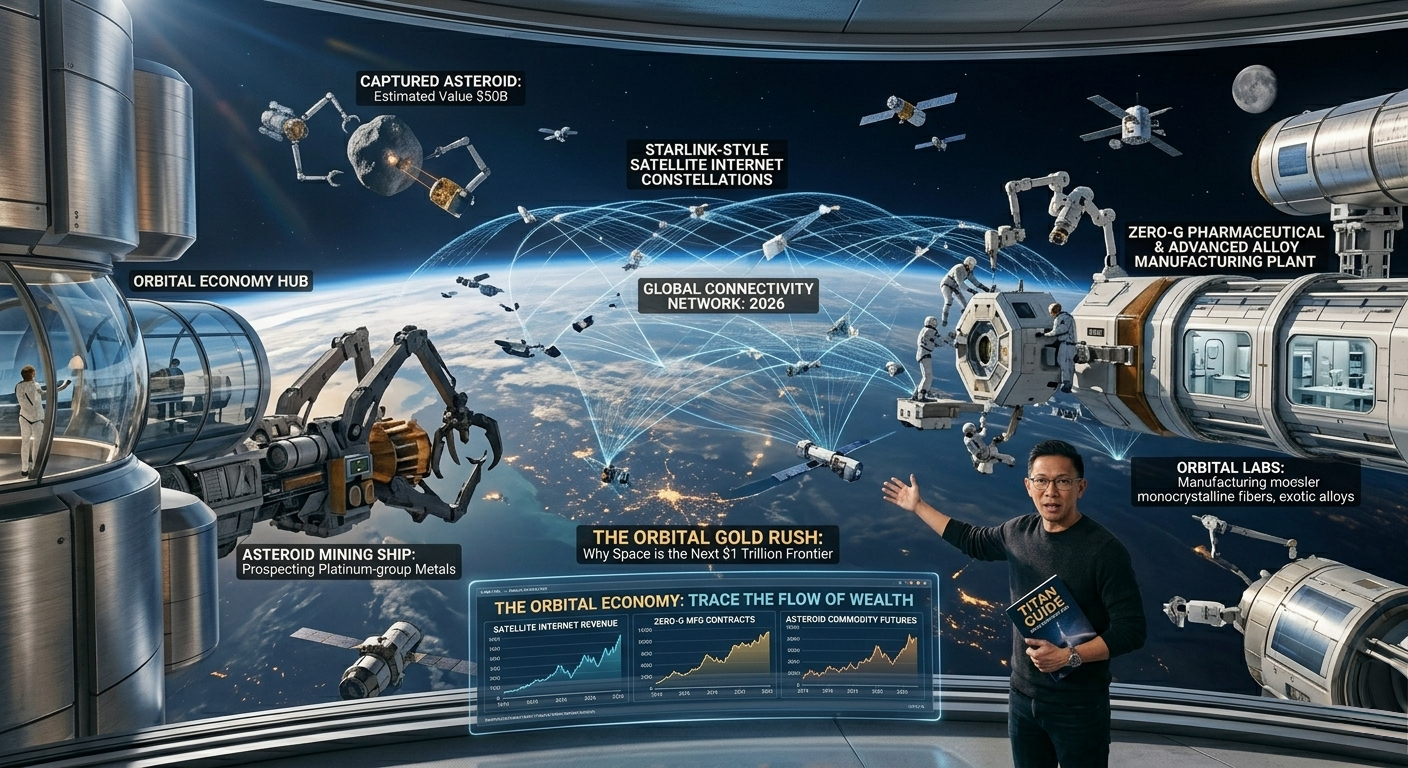
The Orbital Gold Rush: Why Space is the Next $1 Trillion Frontier
1. The Launch Cost Collapse: Breaking the Barrier
The single biggest hurdle to space has always been the cost of gravity. Ten years ago, putting a kilogram of “stuff” into space cost roughly $20,000. Today, thanks to reusable rocket technology pioneered by firms like SpaceX and now being chased by Rocket Lab, that cost has plummeted.
We are entering the era of the “Space Commodity.” When the cost to reach orbit drops, the barrier to entry for private companies vanishes. This has paved the way for thousands of small satellites (CubeSats) that act as the eyes and ears of our global economy, tracking everything from crop yields in India to oil tanker movements in the Strait of Hormuz in real-time.
2. Starlink and the Connectivity Revolution
By mid-2026, the concept of “dead zones” on Earth is becoming a historical curiosity. Mega-constellations are providing high-speed internet to every square inch of the planet. This isn’t just about watching YouTube in the Sahara; it’s about the unbanked billions.
With orbital connectivity, the next generation of investors in emerging markets won’t need a local bank branch; they just need a clear view of the sky. For the savvy investor, this means the growth of fintech and digital assets is now directly tethered to the health of the space sector. If the satellites stop, the money stops.
3. Manufacturing in Zero-G
This is where it sounds like science fiction, but the balance sheets say otherwise. Gravity is actually a “contaminant” for many industrial processes. In the weightlessness of orbit, we can create perfect fiber-optic cables, exotic alloys, and bio-printed human organs that are impossible to build on Earth.
Major pharmaceutical and tech companies are already eyeing “Orbital Labs.” We aren’t just sending humans to space to explore; we are sending them to manufacture. The first company that perfects a mass-market drug or a superior semiconductor in zero-G will hold a monopoly that makes today’s tech giants look small.
4. Space Mining: The Ultimate Hedge
Our planet has a finite supply of rare earth metals, but the belt between Mars and Jupiter is practically paved with them. A single 150-meter asteroid could contain platinum and gold worth billions. While the tech for large-scale mining is still maturing in 2026, the legal and financial frameworks are already being built.
Countries are passing “Space Resource” laws, and venture capital is flowing into prospecting startups. This is the ultimate “long-game.” Investing here requires a stomach for risk, but the payout is quite literally astronomical.
Conclusion: The Risks of the Void
Is it all upside? Of course not. Space is hard, and space is dangerous. A single “Kessler Syndrome” event—where orbital debris triggers a chain reaction of satellite destruction—could set us back decades. Geopolitical tensions between the US, China, and Russia are also spilling over into the stars.
But for those who understand the Titan Mindset, risk is simply the price of admission for unprecedented growth. Space is no longer a dream; it is a line item on the global balance sheet. The question isn’t whether you should invest in space, but whether you can afford to stay grounded while the rest of the world takes off.

Faiz Malik is the founder of Moneydigitals, where he simplifies stock market, crypto, and global investing for beginners. His mission is to help people build wealth smartly with practical insights and real-world strategies.