
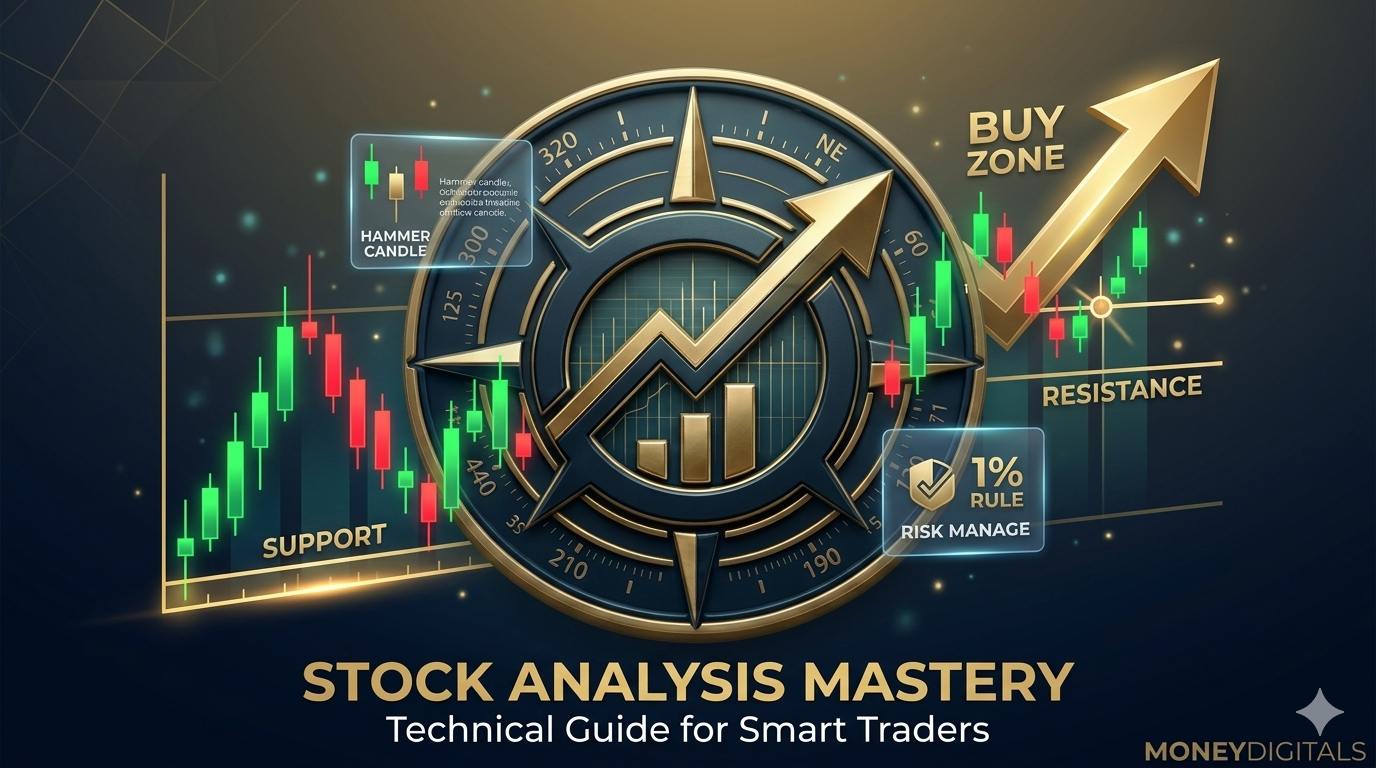
Beyond the Basics: How to Analyze Stocks Like a Pro in 2026
If you have already placed your first trade or at least opened your Demat account, congratulations! You’ve taken a bigger step than 90% of people who only dream about wealth. But now comes the real challenge: How do you stop guessing and start predicting?
At Moneydigitals.com, we don’t believe in “luck.” The stock market is a game of probability. In this second part of our series, we are moving away from simple definitions and diving into the mechanics of making smart, calculated moves.
1. The Art of Technical Analysis: Reading the Pulse
While Fundamental Analysis tells you what to buy, Technical Analysis tells you when to buy. It’s like checking the weather before a flight. You are looking at historical price actions to predict future movements.
The Magic of Candlestick Charts
If you see a chart, you’ll see red and green bars. These are “Candlesticks.” Each candle tells a story of a battle between Buyers (Bulls) and Sellers (Bears):
- The Wick (Shadow): The highest and lowest price the stock touched.
- The Body: The opening and closing price.
- Green Candle: Buyers won. Red Candle: Sellers won.
Pro Tip: Look for a “Hammer” candle at the bottom of a downtrend—it’s often a sign that the price is about to bounce back up!
2. Support and Resistance: The Floor and the Ceiling
Imagine a ball bouncing in a room. The floor is the Support—the price level where buyers usually step in to stop the stock from falling further. The ceiling is the Resistance—the price where sellers jump in to stop the stock from rising.
As a smart trader at Moneydigitals, your goal is to buy near the Support and sell near the Resistance. It sounds simple, but mastering this “Zone Identification” is what separates profitable traders from losers.
3. The Power of Diversification: Don’t Put All Eggs in One Basket
Many beginners fall in love with one stock (like Tesla or Reliance) and put all their money into it. This is dangerous. If that one company has a bad day, your whole portfolio bleeds.
The 5-Sector Rule: A healthy portfolio should have stocks from different industries:
- IT/Technology: For high growth.
- Banking/Finance: The backbone of the economy.
- FMCG: Stable stocks that don’t fall easily (e.g., soap, food companies).
- Energy/Infrastructure: Long-term stability.
- Pharma/Healthcare: Safety during market crashes.
4. Risk Management: The “1% Rule”
Professional traders never risk more than 1% of their total capital on a single trade. If you have $1,000, you should never lose more than $10 in one go. This ensures that even if you have 5 bad trades in a row, you still have enough money to stay in the game. Remember: Survival is the first step to Success.
5. Understanding Market Psychology: Fear vs. Greed
The market doesn’t run on numbers; it runs on human emotions.
- When everyone is greedy and buying (All-time Highs), that is often the best time to be cautious.
- When everyone is scared and selling (Market Crash), that is often the best time to find “Gold” at a discount.
As Warren Buffett famously said: “Be fearful when others are greedy, and greedy when others are fearful.”
6. Setting Up Your Trading Routine
You cannot be a successful trader by just checking your phone once a day. You need a routine:
- Pre-Market (Morning): Check global news and how the US/Asian markets performed.
- During Market: Watch your Support and Resistance levels. Do not over-trade!
- Post-Market (Evening): Review your trades. Why did you win? Why did you lose? Write it in a “Trading Journal.”
Final Thoughts for the Emerging Investor
Trading is not a “Get Rich Quick” scheme. It is a skill, like learning a new language or a musical instrument. You will make mistakes, but as long as you learn from them, you are moving forward. At Moneydigitals.com, we are here to provide the map, but you have to drive the car.
In our next article, we will discuss “Intraday Trading Strategies” for those who want to make daily profits. Stay tuned!
High-Risk Investment Warning
“Trading and investing in the stock market, cryptocurrencies, and global commodities involve significant financial risk. Market volatility can be extreme, especially during periods of geopolitical instability. You may lose some or all of your initial investment. Therefore, you should only invest money that you can afford to lose. We strongly recommend consulting with a certified financial professional or a licensed investment advisor before making any capital allocations.”

Faiz Malik is the founder of Moneydigitals, where he simplifies stock market, crypto, and global investing for beginners. His mission is to help people build wealth smartly with practical insights and real-world strategies.