
Science & Tecnology Decoding the Future: 5 Groundbreaking Technologies That Will Change Humanity by 2030
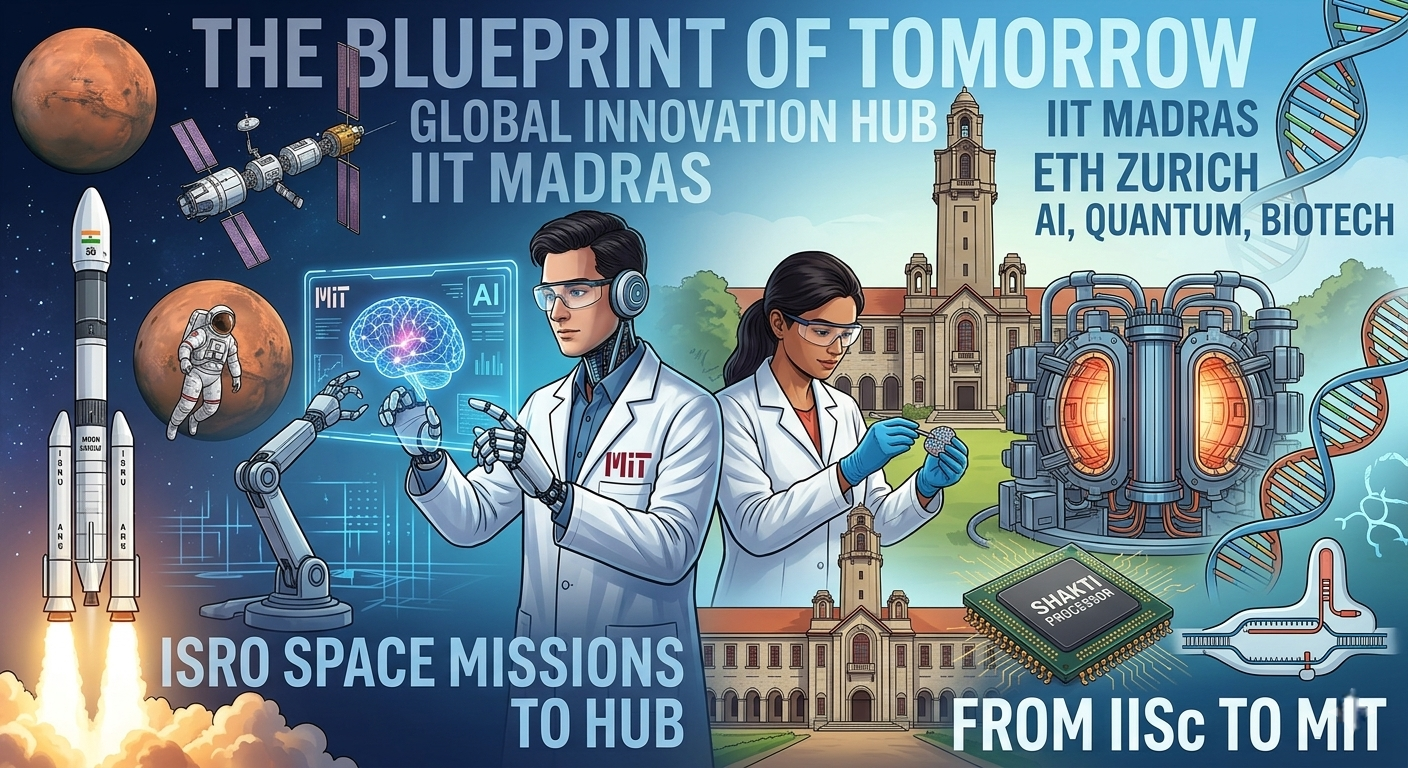
If you look around today, we aren’t just using technology anymore; we are living inside it. We’ve reached a point where the “impossible” has become a weekly headline. But beyond the flashy gadgets and viral AI bots, there is a much deeper shift happening in the labs of MIT, the hallways of IISc Bangalore, and the quiet research rooms of Zurich.
We are currently moving from an age of “Information” to an age of “Creation.” We are no longer just observing nature—we are learning to speak its language.
Where the Real Work is Happening Right Now
Right now, the world’s brainpower is obsessed with three main things: Energy, Intelligence, and Immortality. In the Energy sector, scientists have realized that batteries aren’t enough. We are betting big on Green Hydrogen and Nuclear Fusion. The goal is simple but massive: to create a “Sun on Earth” that provides endless power without killing the planet.
In Intelligence, the focus has shifted from ChatGPT-style bots to embodied AI. This means giving AI a physical body (robotics) so it can understand the world just like a human baby does—by touching, moving, and learning from mistakes.
The Global “Knowledge Hubs”: Who is Actually Leading?
Innovation doesn’t happen in a vacuum. It happens in specific places where the smartest people on Earth gather.
The Ivy League of Innovation
- MIT (Massachusetts Institute of Technology): If you want to see the future of robots, you look at MIT. They aren’t just making machines; they are building “Neural Networks” that mimic the human brain.
- ETH Zurich (Switzerland): This is where the world’s most advanced engineering happens. They are currently leading the way in Quantum Materials—stuff that could make your phone 1000x faster while using 0.1% of the battery.
- Stanford University: Located right next to Silicon Valley, Stanford is the bridge between a “Lab Idea” and a “Million Dollar Startup.” Their focus right now is Bio-Engineering—literally 3D printing human skin and tissue.
The Indian Awakening
India is no longer just a consumer; we are becoming the architects.
- IISc (Indian Institute of Science), Bangalore: This is the heart of Indian research. Scientists here, like Prof. G.U. Kulkarni and his team, are doing world-class work in Nanotechnology. They are working on sensors so small they can detect a single cancer cell in your blood.
- IIT Madras: They have created one of the world’s best deep-tech ecosystems. Their work on the Shakti Processor (India’s own computer chip) is a huge step toward making India “Atmanirbhar” in hardware.
The Faces Behind the Miracles
Science is personal. It’s driven by people who don’t sleep until they find an answer.
- Demis Hassabis: Head of Google DeepMind. He is the guy trying to “solve intelligence.” His work is why AI can now predict diseases before they even show symptoms.
- Dr. Soumya Swaminathan: A familiar name in India who continues to influence global health policy and biotech research, bridgeing the gap between lab science and public safety.
- Elon Musk & The Neuralink Team: While controversial, they are the ones pushing the “Brain-Computer Interface” (BCI). The plan is simple: if you can’t beat the AI, join it by connecting your brain directly to a computer.
The Roadmap: What’s the Plan for 2030 and Beyond?
Science is currently looking at a “Three-Step Plan” for the next decade:
- Decoding the Human Code: By 2030, we expect “Personalized Medicine” to be common. Instead of one pill for everyone, your doctor will give you a medicine designed specifically for your DNA.
- The Quantum Leap: We are planning for a Quantum Internet. This would be an unhackable network where data travels via light particles, making current cybersecurity look like a toy.
- Space Colonization: This isn’t just about Mars anymore. The plan is to build a “Gateway” (a space station around the Moon) that will act as a permanent base for humans.
How Science Sees the Future
Scientists today don’t see “problems”; they see “engineering challenges.” Whether it’s climate change or aging, the modern scientific view is that everything is “code.” If we can understand the code, we can fix the bug.
Development is no longer slow. Because of “Collaborative Science,” a researcher in Delhi can share data with a lab in Boston in seconds. This global brain is why we are developing technology faster in 5 years than we did in the previous 50.

Faiz Malik is the founder of Moneydigitals, where he simplifies stock market, crypto, and global investing for beginners. His mission is to help people build wealth smartly with practical insights and real-world strategies.