
Introduction
Artificial Intelligence (AI) has evolved from an emerging technology into one of the most influential forces shaping the global economy. From cloud computing and autonomous vehicles to healthcare, cybersecurity, finance, and robotics, AI is transforming how businesses operate and creating new investment opportunities for long-term investors.
Over the past few years, companies investing heavily in AI infrastructure, semiconductor manufacturing, cloud platforms, and enterprise software have attracted significant attention from both institutional and retail investors. As AI adoption continues to accelerate in 2026, many investors are searching for the best AI stocks that could benefit from this long-term technological revolution.
This guide explores some of the leading AI companies, explains why artificial intelligence remains a high-growth sector, discusses potential risks, and highlights important factors investors should evaluate before making any investment decisions.
What Are AI Stocks?
AI stocks refer to publicly listed companies that develop, manufacture, or utilize artificial intelligence technologies as a significant part of their business operations. These businesses may design AI chips, cloud computing platforms, machine learning software, robotics solutions, cybersecurity systems, or enterprise AI applications.
Some companies build AI infrastructure, while others integrate AI into products and services used by millions of consumers and businesses worldwide.
Why AI Is One of the Fastest Growing Industries
Artificial Intelligence is becoming an essential component across nearly every industry. Businesses are adopting AI to automate repetitive tasks, improve productivity, enhance customer experiences, strengthen cybersecurity, optimize logistics, and support better decision-making through data analysis.
Governments, multinational corporations, startups, and technology giants continue investing billions of dollars into AI research and development, making the sector one of the most closely watched investment themes of the decade.
Key Factors Driving AI Growth in 2026
- Rapid adoption of Generative AI technologies.
- Increasing enterprise demand for AI-powered software.
- Expansion of cloud computing infrastructure.
- Growing need for AI chips and high-performance processors.
- Automation across manufacturing and logistics.
- Healthcare innovation using machine learning.
- Autonomous driving and robotics development.
- Cybersecurity powered by artificial intelligence.
- Financial institutions integrating AI solutions.
- Government investments in AI infrastructure.
How to Evaluate AI Stocks
Investing in AI companies requires more than simply following market trends. Investors should evaluate a company’s financial strength, revenue growth, competitive advantage, innovation pipeline, profitability, valuation, and long-term business strategy.
Some AI companies generate revenue directly from AI products, while others benefit indirectly by providing hardware, cloud infrastructure, or software platforms supporting AI development.
1. NVIDIA (NASDAQ: NVDA)
NVIDIA remains one of the most recognized names in artificial intelligence due to its leadership in graphics processing units (GPUs) that power AI training and data centers. The company’s hardware plays a critical role in machine learning, cloud computing, autonomous vehicles, scientific research, and enterprise AI applications.
Its strong ecosystem, continuous innovation, and partnerships with major cloud providers have positioned NVIDIA as a key beneficiary of global AI expansion.
| Company | Primary AI Business |
|---|---|
| NVIDIA | AI GPUs, Data Centers, AI Infrastructure |
2. Microsoft (NASDAQ: MSFT)
Microsoft has significantly expanded its AI capabilities through cloud computing, enterprise software, productivity applications, and strategic investments in artificial intelligence. AI features integrated into Microsoft products continue to strengthen its competitive position across enterprise and consumer markets.
Its Azure cloud platform has become one of the leading providers of AI infrastructure for businesses building next-generation AI applications.
3. Alphabet (NASDAQ: GOOGL)
Alphabet continues investing heavily in artificial intelligence across Google Search, cloud computing, digital advertising, healthcare research, autonomous driving technologies, and enterprise AI services. The company’s extensive research capabilities make it one of the world’s most influential AI innovators.
4. Amazon (NASDAQ: AMZN)
Amazon has become a major player in Artificial Intelligence through its Amazon Web Services (AWS) cloud platform. Thousands of businesses use AWS to build, train, and deploy AI applications. The company is also integrating AI into e-commerce, logistics, customer support, advertising, and smart devices.
Its strong cloud infrastructure and continuous AI investments make Amazon one of the leading companies benefiting from the global AI revolution.
5. Meta Platforms (NASDAQ: META)
Meta is investing billions of dollars into AI infrastructure, large language models, recommendation systems, and virtual reality technologies. Artificial Intelligence powers content recommendations across Facebook, Instagram, WhatsApp, and Threads while also improving advertising performance for businesses worldwide.
Meta’s focus on open-source AI research and next-generation computing platforms continues to strengthen its long-term growth strategy.
6. Advanced Micro Devices (NASDAQ: AMD)
AMD has rapidly expanded its presence in high-performance computing and AI accelerators. As demand for AI chips continues to grow, AMD is positioning itself as one of the strongest competitors in the semiconductor industry.
Its processors are increasingly being used in cloud computing, enterprise AI workloads, gaming, and data centers.
7. Broadcom (NASDAQ: AVGO)
Broadcom develops networking equipment, semiconductor solutions, and enterprise software that support AI infrastructure. As organizations expand AI data centers, demand for high-speed networking technologies continues to increase, creating additional opportunities for Broadcom.
8. Oracle (NYSE: ORCL)
Oracle has significantly expanded its AI capabilities by integrating artificial intelligence into cloud infrastructure, enterprise software, and database solutions. Businesses increasingly rely on Oracle Cloud Infrastructure to deploy AI applications securely and efficiently.
9. Taiwan Semiconductor Manufacturing Company (NYSE: TSM)
TSMC manufactures advanced semiconductor chips for many of the world’s leading technology companies. Since AI hardware depends heavily on advanced chip manufacturing, TSMC remains one of the most important companies supporting the entire AI ecosystem.
10. Palantir Technologies (NYSE: PLTR)
Palantir specializes in AI-powered data analytics platforms used by governments, defense organizations, and commercial enterprises. Its Artificial Intelligence Platform (AIP) has attracted increasing attention as businesses seek advanced AI solutions for decision-making and operational efficiency.
Comparison of Leading AI Stocks
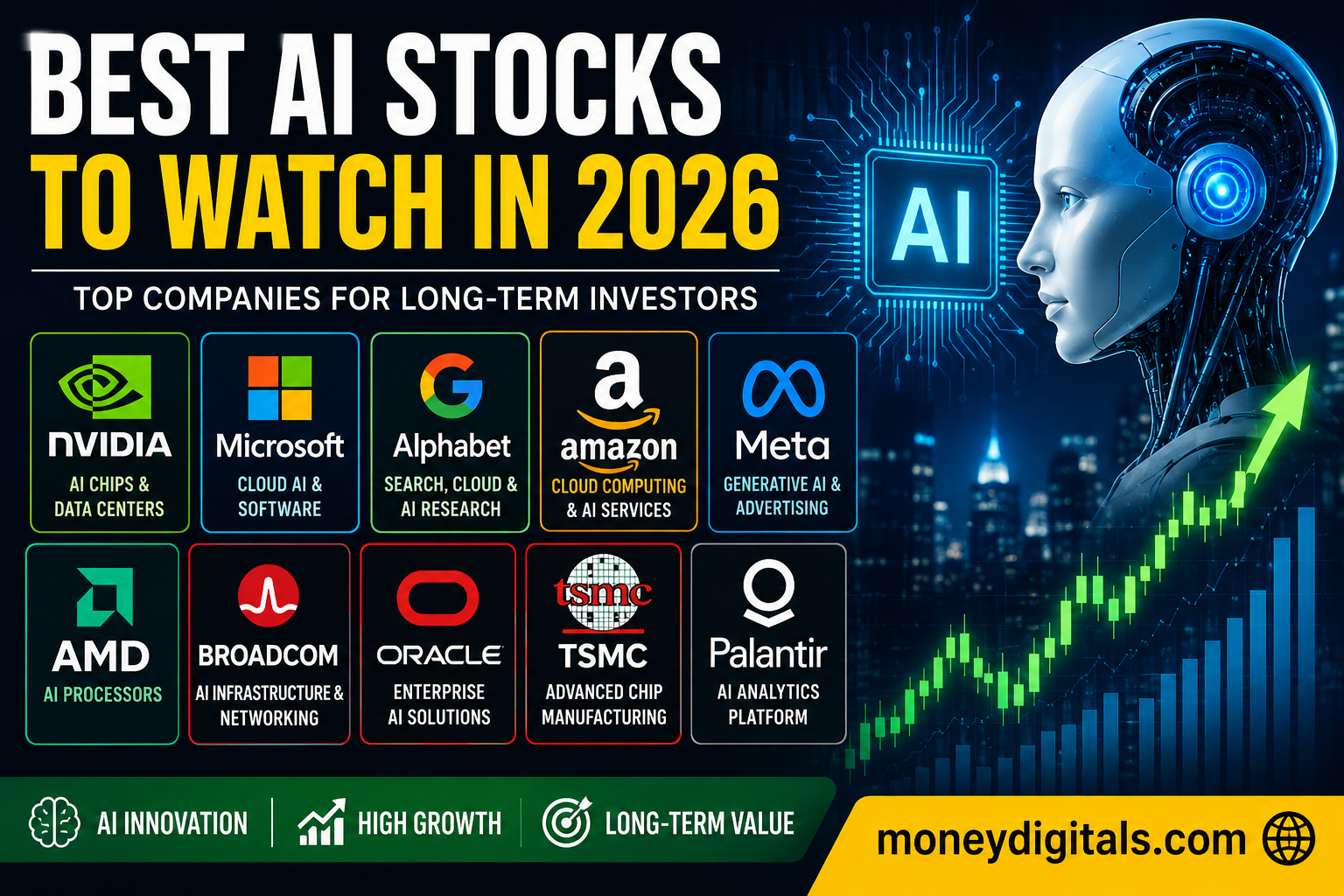
| Company | Primary AI Focus | Sector |
|---|---|---|
| NVIDIA | AI GPUs & Data Centers | Semiconductors |
| Microsoft | Cloud AI & Enterprise Software | Technology |
| Alphabet | Search, Cloud & AI Research | Technology |
| Amazon | Cloud Computing & AI Services | E-commerce / Cloud |
| Meta | Generative AI & Advertising | Social Media |
| AMD | AI Processors | Semiconductors |
| Broadcom | Networking & AI Infrastructure | Semiconductors |
| Oracle | Enterprise AI Solutions | Cloud Computing |
| TSMC | Advanced Chip Manufacturing | Semiconductors |
| Palantir | AI Analytics Platform | Software |
Benefits of Investing in AI Stocks
- Exposure to one of the fastest-growing technology sectors.
- Long-term innovation-driven growth potential.
- Increasing enterprise AI adoption worldwide.
- Expansion of cloud computing and data centers.
- Growing demand for AI chips and infrastructure.
- Diversification across multiple industries.
Risks Investors Should Consider
Although AI offers tremendous opportunities, every investment carries risks. Stock prices can fluctuate because of economic conditions, company earnings, competition, regulations, technological changes, and overall market sentiment.
- High market valuations.
- Intense competition.
- Rapid technological evolution.
- Government regulations.
- Economic slowdown.
- Market volatility.
Should Beginners Invest in AI Stocks?
For beginners, AI stocks can be part of a diversified investment portfolio rather than the only investment theme. Diversification across sectors and asset classes helps reduce overall portfolio risk. Investors should also understand each company’s business model before investing.
AI ETFs: An Alternative to Individual AI Stocks
Not every investor is comfortable selecting individual companies. Exchange-Traded Funds (ETFs) that focus on Artificial Intelligence and technology allow investors to gain exposure to multiple companies through a single investment. This approach can help diversify risk while participating in the long-term growth of the AI industry.
Before investing in any ETF, investors should review its investment objective, holdings, expense ratio, historical performance, and overall diversification.
Future Outlook for AI Stocks
Artificial Intelligence is expected to remain one of the fastest-growing technology sectors over the coming years. Businesses across healthcare, finance, manufacturing, retail, cybersecurity, transportation, and education are continuing to increase investments in AI-driven solutions.
The demand for AI chips, cloud infrastructure, enterprise software, automation, robotics, and machine learning services is expected to support long-term growth for companies operating within the AI ecosystem. However, investors should remember that market performance can vary significantly over shorter time periods.
Key Factors to Monitor Before Investing
- Quarterly earnings growth.
- Revenue generated from AI products and services.
- Research and development spending.
- Cloud computing expansion.
- Semiconductor demand.
- Government regulations related to AI.
- Competitive landscape.
- Global economic conditions.
- Company valuation.
- Long-term business strategy.
Long-Term Investment Tips
Investing in innovative technologies requires patience and disciplined decision-making. Rather than reacting to daily market movements, long-term investors often focus on business fundamentals, competitive advantages, and sustainable growth.
- Invest only after conducting your own research.
- Diversify your portfolio across sectors.
- Review company financial statements regularly.
- Avoid emotional buying during market rallies.
- Consider long-term investment horizons.
- Review your portfolio periodically.
Frequently Asked Questions (FAQs)
1. What are AI stocks?
AI stocks are shares of publicly listed companies involved in developing, manufacturing, or using Artificial Intelligence technologies in their products, services, or infrastructure.
2. Are AI stocks a good long-term investment?
Many investors consider AI a long-term growth theme. However, every investment carries risk, and future performance cannot be guaranteed.
3. Which industries benefit the most from AI?
Technology, healthcare, finance, manufacturing, cybersecurity, cloud computing, retail, transportation, and robotics are among the industries benefiting from AI adoption.
4. Should beginners invest only in AI stocks?
No. Beginners generally benefit from maintaining a diversified portfolio instead of concentrating investments in a single sector.
5. Can AI stocks be volatile?
Yes. Like other technology companies, AI stocks can experience significant price fluctuations due to earnings reports, economic conditions, competition, and market sentiment.
6. How should investors choose AI companies?
Investors should evaluate business fundamentals, financial performance, competitive advantages, valuation, innovation capabilities, and long-term growth prospects before making investment decisions.
Related Articles
- How AI Is Changing Personal Finance in 2026
- Will Oil Prices Fall in July 2026?
- Best Long-Term Investment Options
- ETF vs Mutual Funds: Which Is Better?
Useful Resources
Conclusion
Artificial Intelligence continues to reshape industries worldwide, creating new opportunities for businesses and investors alike. Companies involved in AI infrastructure, cloud computing, semiconductors, enterprise software, and advanced analytics are expected to remain at the center of technological innovation.
While AI stocks offer significant long-term growth potential, successful investing requires careful research, diversification, patience, and an understanding of market risks. Rather than chasing short-term trends, investors should focus on fundamentally strong businesses that demonstrate sustainable innovation and financial performance over time.

Faiz Malik is the founder of Moneydigitals, where he simplifies stock market, crypto, and global investing for beginners. His mission is to help people build wealth smartly with practical insights and real-world strategies.