
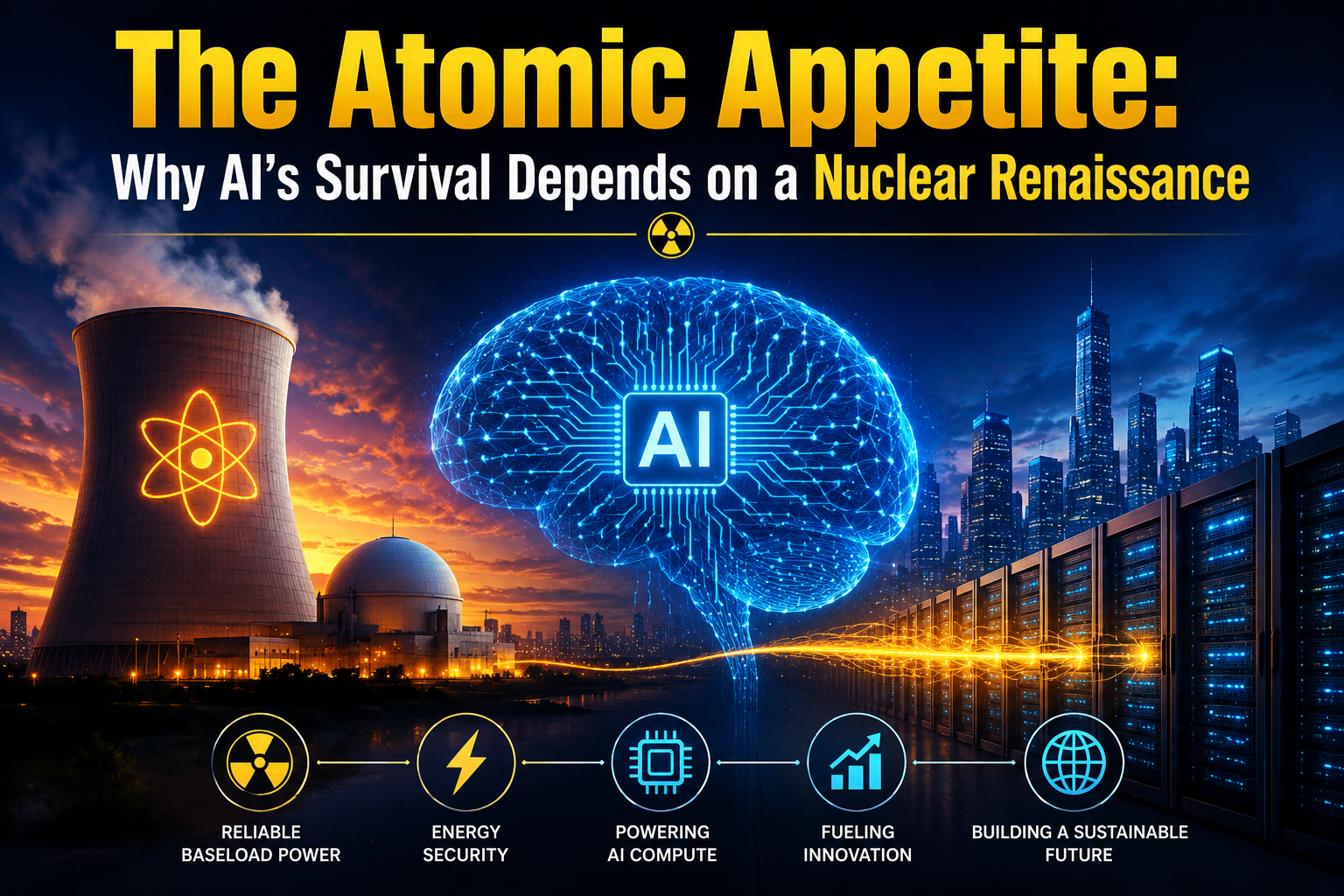
The Atomic Appetite: Why AI’s Survival Depends on a Nuclear Renaissance
As the demand for artificial intelligence grows, Nuclear Power for AI has become the most discussed topic among tech giants like Google and Microsoft. For the last decade, the tech world’s mantra was “The Cloud.” It sounded ethereal, weightless, and clean. But as we enter 2026, the mask has slipped. The Cloud is actually a sprawling network of massive, heat-spewing warehouses filled with silicon and copper. And these warehouses—our data centers—are hungry.
With the explosion of Generative AI, that hunger has turned into an all-consuming famine. The tech giants—Google, Microsoft, and Amazon—have realized a terrifying truth: the current power grid cannot sustain the AI revolution. To save their future, they are turning back to the most controversial and powerful energy source in human history: Nuclear Power.
The Hidden Cost of a Prompt
Every time you ask an AI to generate a poem, a piece of code, or a business strategy, a physical process happens miles away. A GPU (Graphics Processing Unit) in a data center spins up, drawing a surge of electricity and generating intense heat.
To put it in perspective, a single ChatGPT query consumes nearly ten times the electricity of a standard Google search. When you multiply that by billions of users and integrate AI into every software application on earth, the numbers become staggering. We aren’t just talking about a slight increase in demand; we are talking about a total restructuring of global energy needs.
For years, these companies touted “Carbon Neutrality” through solar and wind credits. But there is a fundamental flaw with renewables: the sun sets, and the wind dies down. AI data centers, however, never sleep. They require “Baseload Power”—a steady, unblinking stream of electrons 24 hours a day.
Why Solar and Wind Aren’t Enough
The tech industry is currently hitting the “Renewable Wall.” While solar and wind are fantastic for offsetting carbon, they are intermittent. To run a global AI infrastructure on solar, you would need batteries the size of small cities to store power for the night. The cost and material requirements for those batteries make them unfeasible at the scale AI requires.
This is why the conversation has shifted. If you want carbon-free energy that stays on when the lights go out in the rest of the city, you only have one real option: Nuclear.
The Three Mile Island Plot Twist
Nothing illustrates this shift better than the recent deal between Microsoft and Constellation Energy. In a move that seemed like science fiction just five years ago, Microsoft agreed to help resurrect a unit of the Three Mile Island nuclear plant—the site of the most significant nuclear accident in U.S. history.
Why would a “clean and trendy” brand like Microsoft tie itself to a name associated with nuclear fear? Because they are desperate. The deal guarantees Microsoft 100% of the plant’s output for 20 years. This isn’t just an energy play; it’s a survival play. Without dedicated nuclear power, Microsoft’s AI ambitions would eventually be throttled by a crumbling and overtaxed public grid.
Enter the SMR: The “Pocket” Reactor
The future of this trend isn’t just in massive, old-school power plants. The real “human” innovation happening right now is in Small Modular Reactors (SMRs).
Think of a traditional nuclear plant as a giant, custom-built mainframe computer from the 1960s. An SMR is like a modern server blade. These are smaller, factory-built reactors that can be shipped on a truck and assembled on-site.
Google and Amazon have already started signing deals with companies like Kairos Power and X-energy to deploy these SMRs. The goal is to have a dedicated nuclear reactor sitting right next to the data center. This removes the need for long-distance power lines and ensures that if the public grid fails, the AI stays online. It is the ultimate “off-grid” flex for Big Tech.
The Investor’s Gold Mine: Uranium and Infrastructure
If you follow the money, the trail leads straight to the ground. The price of Uranium has seen a resurgence as countries and corporations realize that “Green AI” is impossible without it.
But it’s not just the miners. It’s the companies building the cooling systems, the specialized concrete for containment, and the high-tension cables required for these hubs. We are witnessing the birth of a new “Energy-Tech” sector. In the stock market, the winners won’t just be the ones making the AI chips (NVIDIA); it will be the companies providing the atoms to power those chips.
The Skeptic’s Corner: What Could Go Wrong?
A human perspective requires us to look at the risks, not just the hype. Nuclear energy, for all its benefits, brings two massive challenges: Waste and Time.
- The Waste Problem: We still don’t have a global, unified solution for long-term spent fuel storage. As tech companies produce more nuclear waste to power our “cat memes” and “business emails,” the ethical debate will intensify.
- The Time Lag: You can build a data center in 18 months. It takes 10 to 15 years to license and build a traditional nuclear plant. Even SMRs are stuck in a regulatory bottleneck. There is a very real possibility that AI demand will outpace the nuclear supply, leading to a “Tech Brownout” in the late 2020s.
The Geopolitical Chessboard
This isn’t just a corporate race; it’s a national security issue. The country that masters the AI-Nuclear synergy first will have a massive economic advantage. China is currently building nuclear reactors faster than any other nation. If the U.S. and Europe get bogged down in regulation, the “Intelligence Age” might be powered by Eastern atoms.
We are seeing a new form of “Tech-Nationalism,” where energy independence is seen as the primary prerequisite for AI supremacy.
Conclusion: A Symbiotic Future
The irony is profound. To power the most advanced, futuristic technology we have ever created (AI), we are returning to a technology we mastered in the 1950s (Nuclear).
It is a reminder that the digital world is not a separate reality. It is tethered to the earth, to the laws of thermodynamics, and to the necessity of physical energy. The “Nuclear Renaissance” is no longer a fringe idea; it is the backbone of the next industrial revolution.
For the average person, this means the electricity that powers your digital assistant might soon come from the splitting of atoms. For the blogger or content creator, it means the most important tech story of the year isn’t a new app—it’s a power plant.
The AI revolution will be nuclear, or it won’t be at all.
While high-end hardware is essential for AI, maintaining the integrity of that data is equally critical. For those interested in professional data retrieval techniques, you can explore our comprehensive PC-3000 Spider Board Data Recovery Guide to understand how complex hardware issues are managed.”

Faiz Malik is the founder of Moneydigitals, where he simplifies stock market, crypto, and global investing for beginners. His mission is to help people build wealth smartly with practical insights and real-world strategies.