
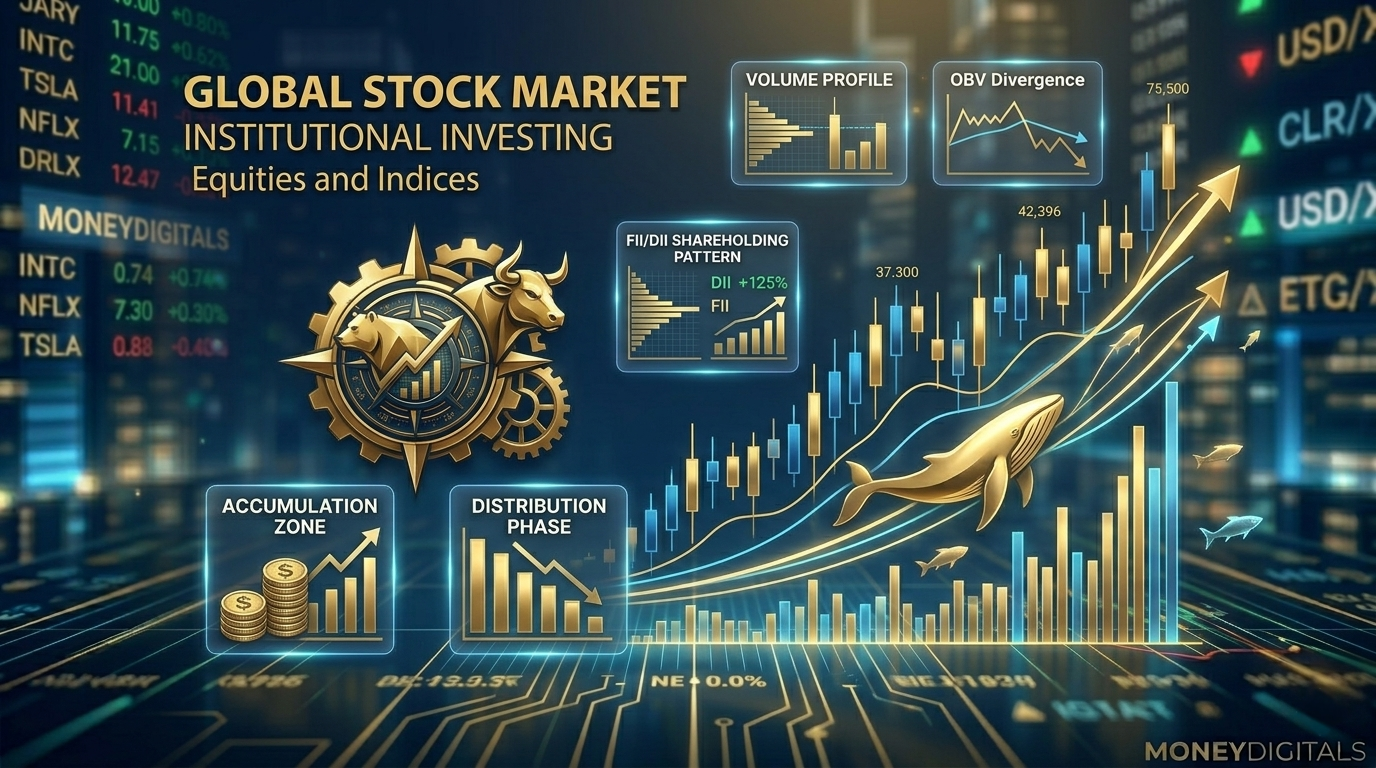
Smart Money Trading: How to Track the Footprints of Global Corporations
In our last post, we revealed the secret strategies large corporations and institutions use to move the stock market. You learned about “whales”—entities with billion-dollar bankrolls who don’t invest; they trade.
But knowledge without action is useless. You know they exist, but do you know where they are right now? Do you know which stock they are quietly accumulating, or which one they are about to dump?
At Moneydigitals.com, we don’t guess. We analyze. Today, we’re giving you the ultimate blueprint to tracking ‘Big Money’ movements. By the end of this guide, you won’t just be reacting to market moves; you’ll be anticipating them.
The Fundamental Problem: The Price Lie
Most beginners focus solely on price. Price can lie. Price can be manipulated by small, temporary orders. Volume, however, never lies. Volume tells you how many shares were actually exchanged at a certain price. Large institutions cannot enter or exit a trade without leaving a massive trail in the volume data. That trail is called “Smart Money Footprints.”
1. Understanding Volume-Price Analysis (VPA)
Volume-Price Analysis is the art of comparing a stock’s price movement to its trading volume over the same period. If price is the car, volume is the fuel. A car can’t go far on an empty tank.
The Anatomy of Institutional Buying
Imagine a stock is in a long downtrend. Price is falling, and volume is low. Suddenly, the price falls to a new low, but the volume is huge. Then, the price closes near its high for the day. This is the first footprint.
The Breakdown:
- Retailers are panic-selling.
- Institutions are absorbing all that selling.
- A lot of shares changed hands, but the price stabilized. This is called “Accumulation” or “Absorption,” and it usually precedes a major rally.
The Anatomy of Institutional Selling
The opposite happens at the top. The stock is in a long uptrend, reaching an all-time high with massive volume. But instead of the price closing at the new high, it reverses and closes near its low for the day. This is the final footprint.
The Breakdown:
- Retailers are greedily buying on “good news.”
- Institutions are happily selling them their shares at a profit.
- The rally is exhausted. The whales are out. This is “Distribution,” and it usually leads to a sharp crash.
2. Spotting the Institutional Indicators
Beyond simple Volume Bars, you need specific tools to track smart money. Here are two essential indicators:
A. On-Balance Volume (OBV)
OBV is a momentum indicator that uses volume flow to predict changes in stock price. If OBV is rising while price is flat, it means smart money is quietly accumulating shares. This is a classic bullish “divergence” and is often followed by a large price spike.
B. Volume Profile
A standard volume bar chart shows volume by time (e.g., 5-minute, 1-hour). Volume Profile shows volume by price level. It reveals the exact price ranges where the most shares were traded, also known as “Value Areas.” Whales love Value Areas because they can hide their large orders there.
3. The Importance of Institutional Ownership Data
You don’t just have to rely on charts. Publicly traded companies in the U.S. and India must report who owns their stock. You can find this data on financial websites under “Institutional Ownership” or “Shareholding Pattern.”
- FII/FPI: Foreign Institutional Investors.
- DII: Domestic Institutional Investors.
Look for this pattern: A stock with low price but steadily increasing DII or FII holdings over several quarters. This is institutional validation of a value stock.
4. Case Study: Anatomy of a Whale Buy Zone
Let’s look at a hypothetical stock, “Aegis Corporation.” It’s traded in the Nifty 50 and is currently in a correction. Here’s how you’d track the smart money:
- Step 1: Check Weekly Charts. Aegis is at a known technical support level (a place where price has bounced before).
- Step 2: Compare Volume. Over the last month of correction, volume has been decreasing. But this week, right at support, volume is 200% higher than the 20-day average.
- Step 3: Analyze the Candle. The weekly candle is a large “Pinbar” or “Hammer,” with a long lower wick, indicating that sellers tried to push price down, but buyers (DII/FII) absorbed the entire order and pushed price back up.
- Conclusion: Smart Money has entered. Retail panic is over. The probable next move is a major trend reversal.
High-Risk Investment Warning
“Trading and investing in the stock market, cryptocurrencies, and global commodities involve significant financial risk. Market volatility can be extreme, especially during periods of geopolitical instability. You may lose some or all of your initial investment. Therefore, you should only invest money that you can afford to lose. We strongly recommend consulting with a certified financial professional or a licensed investment advisor before making any capital allocations.”

Faiz Malik is the founder of Moneydigitals, where he simplifies stock market, crypto, and global investing for beginners. His mission is to help people build wealth smartly with practical insights and real-world strategies.