
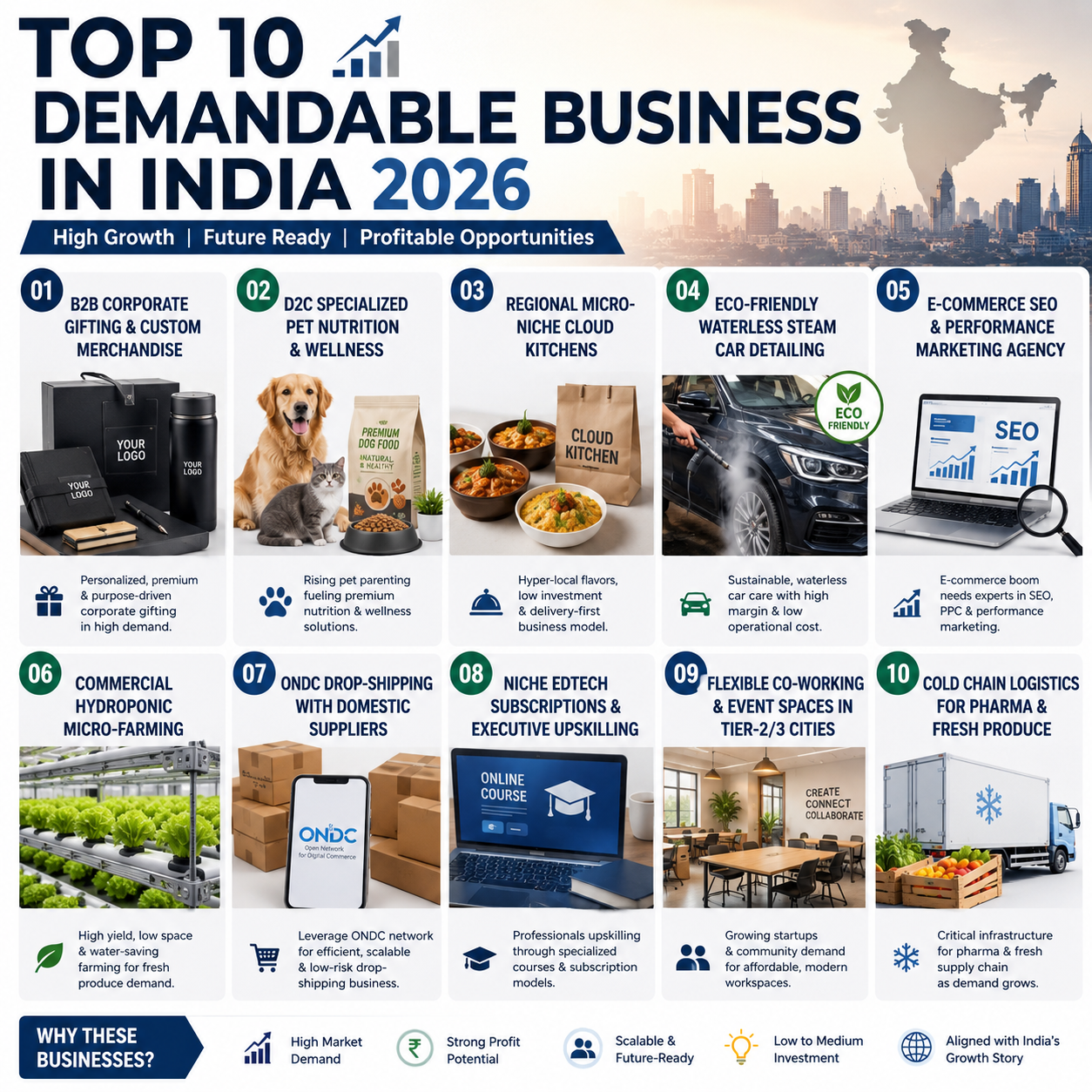
Top 10 Most In-Demand High-Margin Businesses in India (2026)
A Data-Backed Guide to Actionable, High-Value Entrepreneurial Ventures
The Core Blueprint for High-Value Content
Before diving into the list, any high-value business plan must balance three operational pillars:
- Unit Economics: Ensuring gross margins remain above 35% after accounting for customer acquisition costs (CAC).
- Regulatory Compliance: Securing local and national registrations early to avoid operational bottlenecks.
- Market Scalability: Choosing sectors backed by consumer behavior shifts, such as the rapid digitalization of Tier-2 and Tier-3 cities.
Top 10 High-Demand Businesses in India
1. B2B Corporate Gifting & Custom Merchandise
Corporate culture in major Indian hubs like Bengaluru, Hyderabad, and Gurugram has shifted from generic festive gifts to personalized, eco-friendly onboarding and appreciation kits. Companies look for end-to-end vendors who can handle curation, customized branding, and direct pan-India shipping ## Conclusion.
| Financial Metrics | Operational Requirements |
|---|---|
| • Initial Investment: ₹1.5 Lakhs – ₹3 Lakhs • Gross Profit Margin: 30% – 40% • Target Audience: Mid-to-large-scale corporate HR teams, tech startups. | • Core Licenses: GST Registration, Import Export Code (IEC) if sourcing global materials. • Primary Infrastructure: E-commerce storefront, reliable printing and packaging vendors. |
How to Add Unique Value: Do not just sell mugs and t-shirts. Partner with local Indian artisans or sustainable brands to offer premium handcrafted premium gift boxes. Pitch directly to HR managers via LinkedIn with tailored physical sample boxes rather than digital catalogs.
2. D2C Specialized Pet Nutrition & Wellness Brands
The Indian pet care market has moved past standard commercial kibble. Pet parents in urban centers are actively seeking preservative-free, personalized fresh diets, organic grooming supplies, and specialized wellness products for chronic pet health conditions high-margin-businesses-in-india.
- Initial Investment: ₹2 Lakhs to ₹4 Lakhs (for ingredient sourcing, packaging, and kitchen setup).
- Profit Margins: 35% to 45%.
- Essential Licenses: FSSAI under the animal feed category, local Municipal Corporation NOC, and GST registration.
3. Hyper-Local Cloud Kitchens with Regional Micro-Niches
The general multi-cuisine cloud kitchen space is heavily saturated, leading to massive customer acquisition costs on food aggregator platforms. The current high-profit strategy relies on hyper-focused regional micro-niches—such as authentic Champaran meat, authentic South Indian filter coffee/breakfast setups, or strict keto/diabetic meal subscription boxes.
Secure Mandatory Licensing (Weeks 1-3)
Obtain a state or central FSSAI License, a local municipal Health Trade License, and a Fire NOC. Register for GST immediately to partner with commercial food delivery platforms.
Optimize the Menu for Delivery Unit Economics (Week 4)
Keep raw material waste below 5% by designing a compact menu of 12-15 high-margin items that utilize overlapping ingredients.
Platform Integration & Local SEO (Weeks 5-6)
Onboard onto Swiggy, Zomato, and ONDC. Set up your Google My Business profile with highly localized search terms like “authentic regional food delivery near me.”
4. Eco-Friendly, Waterless Steam Car Detailing Units
Traditional commercial car washes waste up to 200 liters of water per vehicle, making them a target for strict local municipal regulations in water-scarce urban pockets. High-pressure steam detailing uses less than 5 liters of water per car and offers premium deep-cleaning solutions directly at the customer’s doorstep.
- Initial Capital: ₹3 Lakhs – ₹5 Lakhs (for commercial-grade portable steam generators, wet/dry vacuums, and eco-friendly chemical detailing kits).
- Gross Margin: 50% to 60% on premium paint correction and ceramic coating services.
- Target Segment: High-end residential societies, luxury car owners, and corporate parking lots via monthly subscription contracts ## Conclusion.
5. Specialized SEO & Performance Marketing Agencies for E-commerce
General digital marketing agencies struggle to justify their retainers because they offer broad, unquantifiable services. In contrast, specialized agencies that focus exclusively on improving Shopify conversion rates, technical Rank Math/SEO optimization, or high-ROI programmatic Meta/Google ad structures for e-commerce brands are in massive demand.
- Setup Cost: Minimal (under ₹50,000 for industry software subscriptions like Ahrefs/SEMrush and high-performance hosting).
- Profit Margin: Up to 70% (highly dependent on your specialized technical skill set).
Client Acquisition Strategy: Publish deeply detailed, public case studies showing exactly how you fixed a specific website’s conversion or indexing issues (such as resolving Google Search Console 403 or 404 crawl errors)
🔄 Read Also: Agentic AI: Future of Jobs & Enterprise Automation
6. Hydroponic Commercial Micro-Farming Units
With urban real estate premiumized, hydroponic farming allows entrepreneurs to cultivate high-value exotic greens (such as Italian basil, curly kale, baby spinach, and cherry tomatoes) in highly controlled vertical indoor spaces without soil high-margin-businesses-in-india.
| Operational Parameter | Detailed Metric |
|---|---|
| • Setup Cost (Small Commercial) | ₹5 Lakhs – ₹8 Lakhs for climate-controlled polyhouse & automation |
| • Monthly Operating Cost | Low (Recirculated nutrient water reduces overall resource waste) |
| • Primary Sales Channels | Premium supermarket chains, B2B hotel/restaurant chefs, ONDC |
7. Custom Drop-shipping via Localized ONDC Networks
Standard global drop-shipping via platforms like AliExpress suffers from long shipping delays and high customs compliance issues in India. The updated high-value model involves sourcing high-quality, specialized products directly from local domestic manufacturers and listing them across India’s open ONDC (Open Network for Digital Commerce) protocols.
- The Advantage: Shipping cycles drop from weeks to 48-72 hours using integrated domestic logistics partners like Delhivery or Shiprocket.
- High-Margin Niches: Ayurvedic wellness products, handmade lifestyle accessories, and sustainable home decor items.
- Key Focus: Spend capital strictly on high-converting ad copy and product packaging rather than physical inventory holding costs.
8. Niche EdTech Subscriptions & B2B Executive Upskilling
The massive mass-market K-12 education platforms have faced severe market corrections due to unsustainable overheads. The profitable micro-niche lies in live, cohort-based professional upskilling programs targeting highly specialized technical industries—such as algorithmic financial trading, AI prompt architecture, or complex international tax compliance.
- Revenue Model: High-ticket weekend boot camps or structured monthly recurring subscription models.
- Infrastructure: A robust Learning Management System (LMS) setup, interactive community platforms, and high-speed streaming infrastructure.
9. Flexible Co-Working & Micro-Event Spaces in Tier-2/Tier-3 Cities
Remote and hybrid work structures have caused a reverse migration of skilled professionals back to Tier-2 and Tier-3 urban centers (such as Indore, Jaipur, Lucknow, and Coimbatore). These regions lack reliable corporate infrastructure, making plug-and-play shared working spaces highly lucrative.
- Implementation Strategy: Partner with local commercial property owners using a revenue-sharing model to keep capital expenditure low.
- Monetization Angles: Daily hot-desks, dedicated corporate meeting rooms, and renting out the space for weekend community or micro-networking events ## Conclusion.
10. Cold Chain Logistics for Pharmaceuticals & Fresh Produce
One of the biggest pain points in India’s supply chain infrastructure is the massive spoilage of temperature-sensitive items, including vaccines, biological drugs, and fresh agricultural exports. Setting up specialized micro-cold storage units or temperature-controlled transit logistics solves a critical, high-paying B2B challenge.
- Investment Scale: Medium to High (requires specialized refrigerated transport units and continuous IoT temperature monitoring infrastructure).
- Compliance Check: Mandatory state transport permits, rigorous FSSAI compliance, and specialized pharma distribution clearings where applicable high-margin-businesses-in-india.
- https://udyamregistration.gov.in
Frequently Asked Questions (FAQs)
Q1. What are the absolute initial licenses required to start any commercial business in India?
Ans. At a foundational level, you require an MSME Udyam Registration (which provides access to priority sector bank loans), a local municipal Shop and Establishment Act License, a permanent Current Bank Account under your business name, and a GSTIN (Goods and Services Tax Identification Number) for standardized inter-state billing.
Q2. Why is Google rejecting niche business listicles under the ‘Low Value’ flag?
Ans. Google algorithms easily flag content that merely lists ideas without outlining actionable execution metrics. To provide real value, an article must explain the underlying financial risks, unit economics, legal compliances, and localized barriers to entry.
Q3. How does integrating with ONDC benefit new e-commerce startups over Amazon or Flipkart?
Ans. ONDC significantly lowers entry barriers by charging drastically lower platform commissions (typically 3% to 5%) compared to traditional e-commerce marketplaces which can charge 15% to 25%. This preserves crucial gross margins for early-stage bootstrapped businesses high-margin-businesses-in-india ## Conclusion.

Faiz Malik is the founder of Moneydigitals, where he simplifies stock market, crypto, and global investing for beginners. His mission is to help people build wealth smartly with practical insights and real-world strategies.