
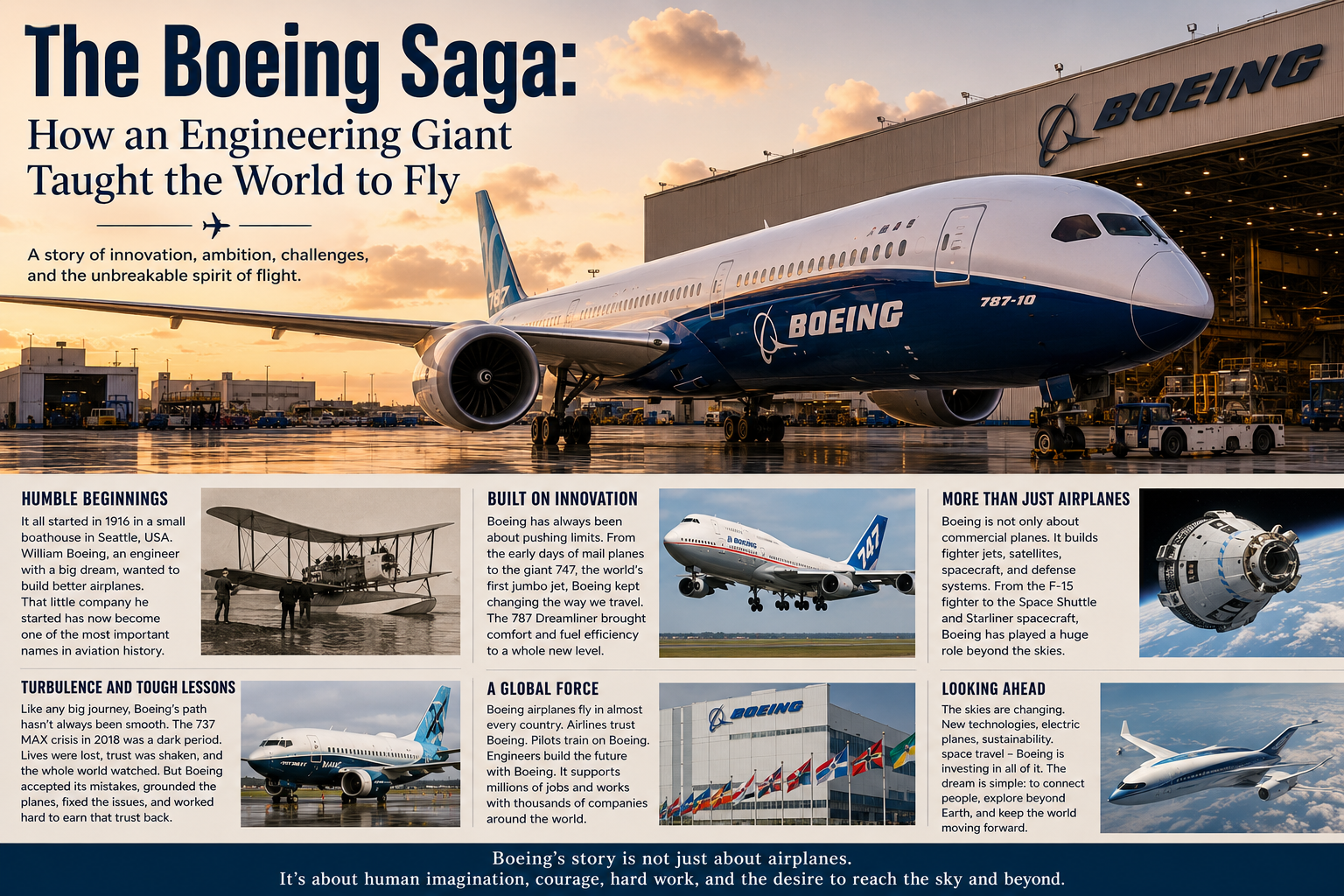
Boeing aviation history
The Boeing aviation history is not just about metal and engines; it is a century-long narrative of massive risks and iconic triumphs. For most of us, “Boeing” is just a word we see printed near the cabin door as we board a flight. But behind that name lies a century of high-stakes gambles, era-defining triumphs, and a recent, sobering struggle to reclaim its soul. Boeing didn’t just build planes; it practically invented the modern world by making “distance” an obsolete concept.
From a Seattle Boathouse to Air Superiority
The story didn’t start in a boardroom, but in a rainy Seattle boathouse in 1916. William Boeing wasn’t just a businessman; he was an engineering obsessive. At a time when most people saw airplanes as dangerous toys, he saw a logistics revolution.
Boeing’s early reputation was built on “over-engineering”—making planes tougher than they actually needed to be. This grit made them the “Arsenal of Democracy” during World War II, producing legends like the B-17 Flying Fortress. This era cemented a culture where engineering was king, and safety was the only metric that mattered.
The Queen of the Skies and the Jet Age
After the war, Boeing took a risk that would have bankrupted almost any other company: putting jet engines on passenger planes.
- The 707 Revolution: Before the 707, long-distance travel was a bone-rattling, days-long ordeal. The 707 made it fast, smooth, and quiet. It effectively “shrunk” the planet for the first time.
- The Jumbo Gamble: In 1969, the Boeing 747 took flight. It was a monster of an aircraft. By carrying over 400 people at once, it forced airlines to drop ticket prices. Suddenly, international travel wasn’t just for the elite; it was for everyone.
The “Other” Boeing: Defense and the Stars
Boeing’s muscle stretches far beyond the airport terminal. They are a titan of global security and exploration.
- Military Power: From the Apache helicopter to the F/A-18 fighter, Boeing’s defense wing provides the hardware for global stability. This side of the house is crucial because government contracts provide a financial cushion when the commercial airline market hits a recession.
- Space Frontier: Boeing has been NASA’s right hand since the days of the Moon landing. While recent projects like the Starliner have faced technical hurdles, Boeing’s footprint in satellite tech and the International Space Station remains a cornerstone of human spaceflight.
The 737 MAX Crisis: A Harsh Reality Check
You can’t tell an honest story of Boeing without looking at its darkest hour. The 737 MAX tragedy wasn’t just a technical failure; many believe it was a cultural one. In a desperate sprint to beat its rival Airbus, the company’s internal focus seemed to shift from “engineering first” to “shareholder value first.”
The two crashes led to a global grounding and a massive loss of public trust. It was a brutal reminder to the entire industrial world: in aviation, shortcuts eventually catch up with you. Rebuilding that “engineering-first” reputation is now the most important mission in Boeing’s history.
Conclusion: The Legacy in the Clouds
Today, Boeing remains a pillar of global connectivity. Every single day, millions of people trust their lives to Boeing’s wings. While the company has faced immense turbulence, its contribution to human history is undeniable. As we move toward a future of “green” aviation and autonomous flight, the world is watching to see if this century-old giant can find its North Star again.
Note: The Engineering Spirit
As a long-time observer of the aviation industry, I believe Boeing’s story is a profound reminder that corporate legacy is fragile. It takes 100 years to build a reputation for “engineering excellence” and only a few years of prioritizing profit over people to damage it. However, the resilience shown in Boeing aviation history suggests that when this giant focuses on its roots—innovation and safety—it is truly unstoppable. Watching how they navigate the next decade of “green” flight will be the ultimate test of their comeback.
Read More: Did you know how Red Bull makes so much profit without ever being on the stock market? Check out our previous article here:https://moneydigitals.com/why-red-bull-is-profitable-without-public-stock/

Faiz Malik is the founder of Moneydigitals, where he simplifies stock market, crypto, and global investing for beginners. His mission is to help people build wealth smartly with practical insights and real-world strategies.