
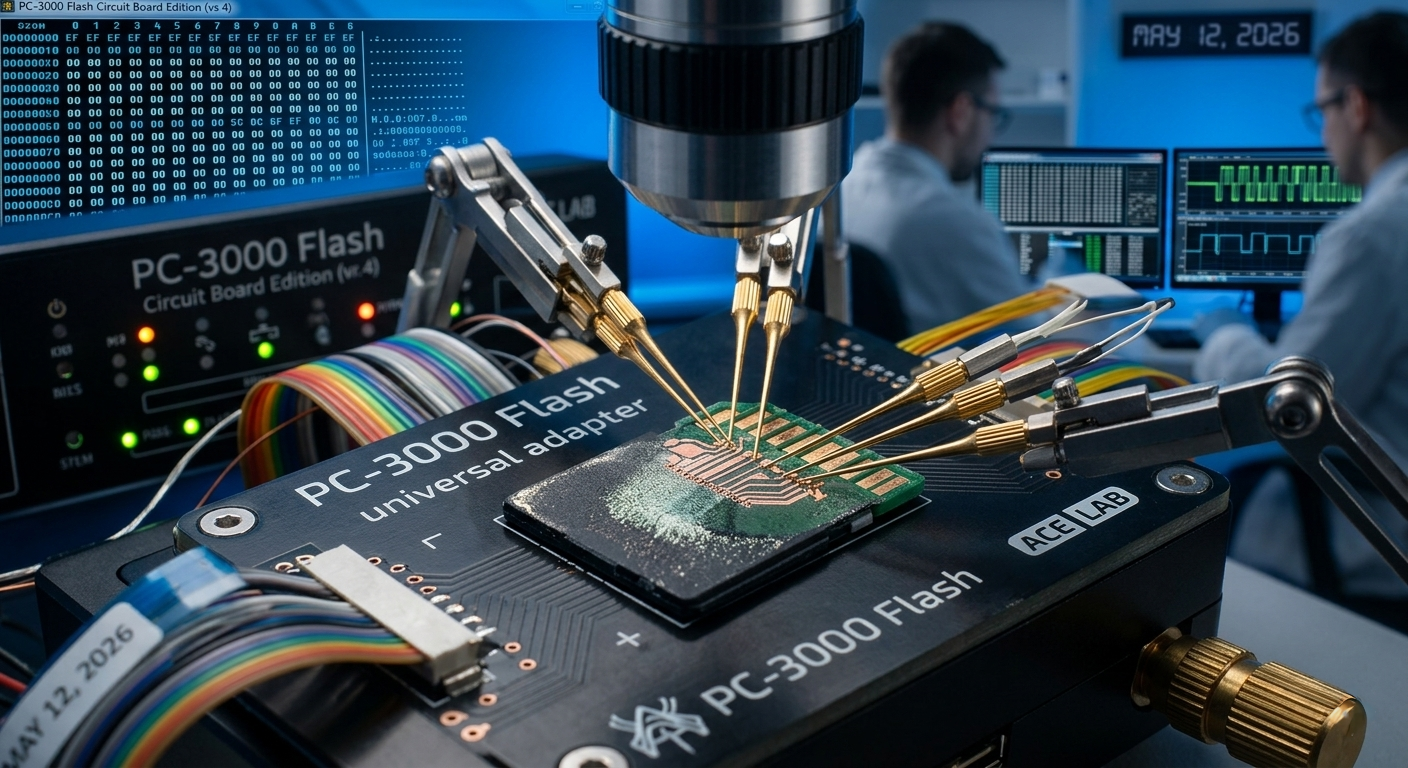
If you’ve ever worked in a data recovery lab, you know the feeling of absolute dread when a customer walks in with a snapped microSD card. In the old days, we’d just look at them and shake our heads. “It’s gone,” we’d say. But then came a company from Europe called ACE Lab, and they changed the rules of the game forever.
.Link: https://www.acelab.eu.com/
They didn’t just build a tool; they built a bridge between a dead piece of plastic and the precious memories inside it. They called it the PC-3000 Spider Board. And let me tell you, it’s the most intimidating yet beautiful piece of tech you’ll ever see on a workbench.
Why the “Spider” was Even Necessary
To understand why this thing exists, you have to understand how much manufacturers hate us (the repair guys).
A decade ago, a USB drive had a controller and a memory chip. Easy. But now? Everything is a Monolith. It’s one solid block. There are no chips to remove. To get data out of a broken 2026-era SD card, you have to “tap” into the microscopic copper lines hidden under the surface.
Before the Spider Board, we had to solder wires as thin as a spider’s web. One tiny mistake with the soldering iron and poof—the data was toast. The Spider Board was born out of this desperation. ACE Lab saw technicians struggling and said, “What if we create a tool with 25 adjustable needles that can just ‘touch’ the board instead of soldering it?”
The Secret History: ACE Lab’s Masterpiece
The design didn’t happen overnight. ACE Lab spent years in R&D (Research and Development). They finalized the design around 2017-2018 and fully completed the software integration by the time the tech world shifted entirely to monolithic storage.
What makes it special is the precision. You can move each “leg” of the spider independently. It’s like performing surgery on a grain of rice. The company is based in Prague, and they are essentially the “Apple” of data recovery—high prices, but nobody does it better.
1. The Technical “Nuts and Bolts”: Hardware Specifications
To truly understand the power of the PC-3000 Spider Board, one must look at the surgical precision of its engineering. This isn’t just a circuit board; it’s a specialized interface designed for the most microscopic tasks in the digital world.
- The 25-Needle Precision System: The board features 25 independent, highly flexible needles. These aren’t just ordinary pins—they are crafted from specialized alloys designed to minimize “signal noise.” In data recovery, even a tiny bit of electromagnetic interference can corrupt a bit of data. These needles ensure a “clean” path from the memory cell to the software, allowing for a pristine data dump.
- Version 4 Compatibility: A crucial detail for any serious pro is that the Spider Board is specifically engineered to work with the PC-3000 Flash Circuit Board Edition (version 4). This compatibility ensures that the high-speed data transfer required for 1TB chips is handled without bottlenecks.
- Microscope-First Design: You don’t use this tool with the naked eye. It is designed to sit perfectly under a laboratory-grade microscope. It also features heavy-duty screw connectors for VCC (Power) and GND (Ground). This “locked-in” stability ensures that once you find a connection, it doesn’t budge—preventing accidental shorts that could fry the data forever.
2. The “Monolith” Nightmare of 2026
As we move through 2026, the storage industry has shifted almost entirely to “Monolith” architecture. While this makes our devices smaller and waterproof, it makes data recovery a living nightmare.
- The Complexity Tax: With MicroSD cards now hitting the 1TB and 2TB marks, the internal architecture is incredibly dense. The “traces” (the copper lines carrying data) inside these chips are now thinner than a spider’s silk. Standard tools simply cannot “see” or “touch” these lines without the precision of the Spider Board.
- Bypassing the “Digital Dead-End”: When a controller chip dies, a standard card reader sees nothing. It’s a dead device. The Spider Board ignores the operating system’s rules and performs a “Raw Dump.” It pulls the raw, uncorrected data out, which is then reconstructed using complex algorithms like XOR patterns and ECC (Error Correction Code) within the PC-3000 software suite.
3. The Frontline of Justice: Forensic & Law Enforcement Use
The PC-3000 Spider Board isn’t just for recovering family photos; it is a critical weapon in the fight against high-tech crime.
- Digital Forensics at the Highest Level: From the FBI in the United States to Interpol in Lyon, ACE Lab’s tools are the gold standard. When a device is recovered from a crime scene, the Spider Board is often the only way to access it.
- Recovering “Destroyed” Evidence: Criminals often try to physically destroy evidence—snapping cards, biting them, or even attempting to burn them. As long as the internal NAND silicon isn’t cracked, the Spider Board can tap into the Host Protected Area (HPA). This is a hidden part of the memory where deleted messages, encrypted logs, and “shredded” files often leave a ghost-trace that standard forensic software simply cannot find.
4. The Business Angle: Cost vs. Reward
In the world of high-end tech, the question isn’t “How much does it cost?” but rather “How much is your data worth?”
- The Investment of a Lifetime: A full PC-3000 setup, including the Spider Board, can cost several thousand dollars. For a hobbyist, this is insane. But for a business losing a multi-million dollar crypto wallet or a corporation losing its intellectual property, that price tag is a drop in the ocean.
- The 80% Success Revolution: Before the Spider Board era, the success rate for recovering data from physically damaged monoliths was a dismal 20-30%. It was mostly guesswork and luck. With the introduction of the Spider Board’s precision needles, that success rate has skyrocketed to nearly 80%. It has effectively turned “Mission Impossible” into a standard daily procedure for top-tier labs.
The $200 Million Miracle: Real-Life Recovery
You want to hear a crazy story? There’s a legendary case (often discussed in forensic circles) where an early crypto investor had his private keys on a micro-SD that was physically crushed.
We’re talking about a card that looked like it had been through a blender. Standard recovery was impossible. But a specialized lab used the Spider Board to bypass the shattered controller. By connecting the pins directly to the NAND traces, they recovered the wallet. That “dead” piece of plastic was worth over $200 million. That’s the power of this tool. It turns “Impossible” into “Done.”
How it Actually Happens (The Dirty Work)
It’s not just “plug and play.” Here is how a pro does it:
- The Sanding: You take the dead card and carefully sand off the black coating until you see the shiny copper “test points.”
- The Alignment: You put the card under a high-powered microscope.
- The Connection: You adjust the Spider’s needles. One for Power (VCC), one for Ground (GND), and several for the Data lines.
- The Dump: Once the lights on the PC-3000 Flash unit turn green, you start “sucking” the raw data out. It’s a slow process, but watching those files reappear is like magic.
Why You Should Care in 2026
Whether it’s your drone’s crash footage or a company’s financial records, everything is getting smaller. The PC-3000 Spider Board is the only thing standing between a broken device and total data loss. For a blogger like me, and a creator like you, it’s a reminder that in tech, nothing is ever truly “deleted” or “broken” if you have the right tools.

Faiz Malik is the founder of Moneydigitals, where he simplifies stock market, crypto, and global investing for beginners. His mission is to help people build wealth smartly with practical insights and real-world strategies.