
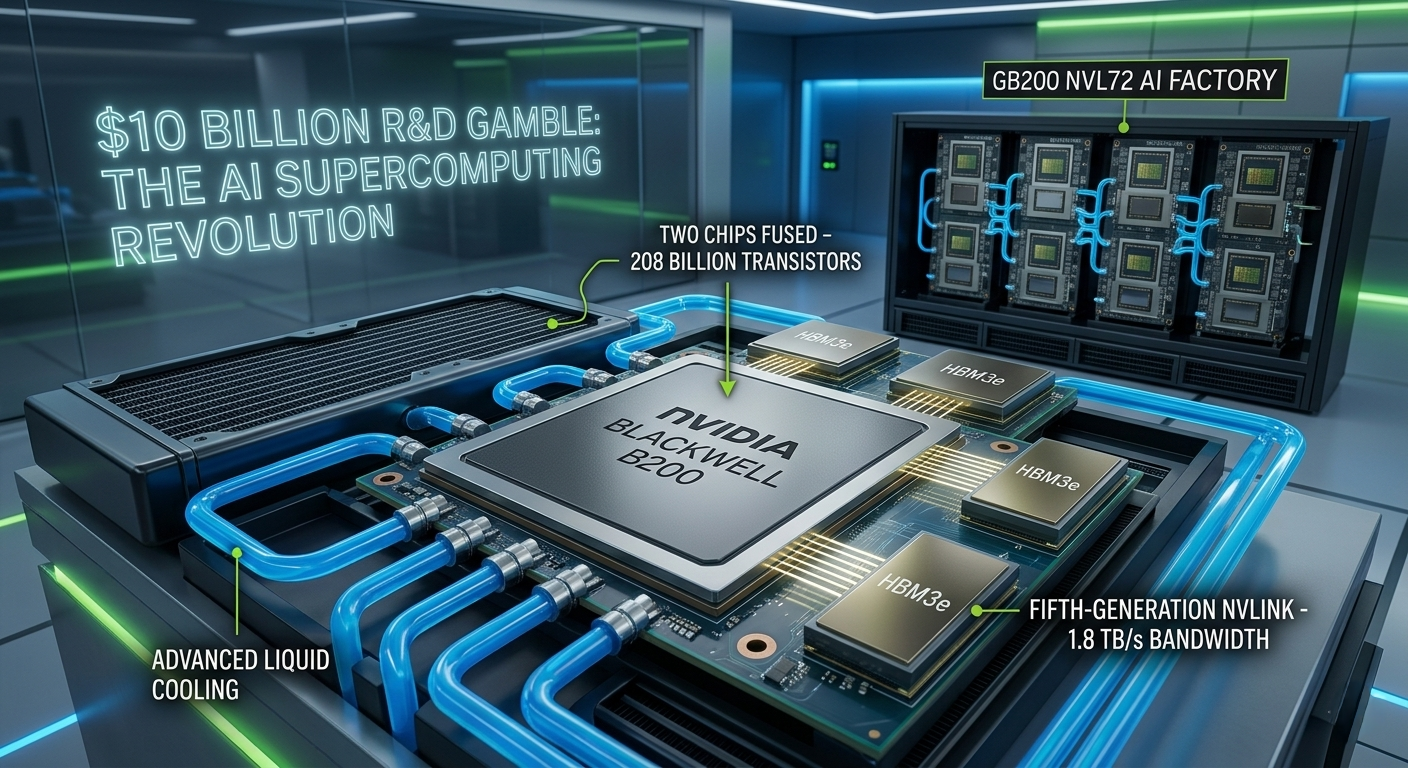
The tech world is buzzing with the launch of NVIDIA Blackwell, a revolutionary GPU architecture that is set to redefine the future of AI supercomputing. We’ve heard about “revolutionary” tech every other month, but what NVIDIA just did with the Blackwell architecture is actually different. This isn’t just about making things a bit faster; it’s about a massive shift in how we build the brains of the future.
The Real Story Behind the Hardware
When you look at the Blackwell B200, you’re not just looking at one piece of silicon. NVIDIA’s engineers did something pretty clever: they took two of the largest possible dies (the actual “chips”) and fused them together. They used a high-speed link called NVLink so these two halves talk to each other as if they are one single, giant unit.
The result? A beast of a chip with 208 billion transistors. To put that in perspective, that’s hundreds of billions of tiny switches working in sync to process data. It’s the kind of scale that was unthinkable just a few years ago.
How it Actually Works: The Supercomputer Vision
NVIDIA isn’t just selling a card you can plug into a PC. They are selling entire “racks” of power. The GB200 NVL72 system is basically a giant supercomputer in a box. https://www.nvidia.com
One of the coolest parts (literally) is the Liquid Cooling. These chips pull so much power that fans just can’t keep up anymore. So, NVIDIA built a plumbing system of sorts—cold liquid flows through pipes directly over the hardware, soaking up the heat. It’s whisper-quiet and incredibly efficient, which is a huge deal for massive data centers that usually sound like jet engines.

Focus point
1. Fifth-Generation NVLink (Unmatched Scalability)
The backbone of the Nvidia Blackwell architecture is the new fifth-generation NVLink interconnect. This technology is a massive leap forward, providing a staggering 1.8 TB/s (Terabytes per second) of bidirectional bandwidth per GPU. In a massive AI cluster, this ensures that thousands of GPUs can communicate with each other without any data “bottlenecks.” By eliminating these delays, Nvidia Blackwell can reduce the time required to train the most complex AI models from months down to just a few weeks.
2. Dedicated Decompression Engine
One of the most innovative features of Nvidia Blackwell is its dedicated Decompression Engine. Typically, when vast amounts of data are moved across a network, they are compressed to save space, which puts a heavy processing load on the CPU. Nvidia Blackwell handles this task natively on the chip, offloading the work from the CPU and accelerating data analytics. This allows for 20x faster data throughput, which not only boosts performance but also significantly lowers the overall power consumption of large-scale data centers.
Let’s Talk Numbers: The $10 Billion Gamble
Building something this advanced isn’t cheap. NVIDIA spent around $10 billion in R&D just to get Nvidia Blackwell off the ground. Because of that massive investment, these chips aren’t for the casual user.
- The Price Tag: A single B200 GPU is expected to cost between $30,000 and $40,000.
- The Big Players: Even at that price, the demand is through the roof. Companies like Google, Meta, and Microsoft are already buying them in bulk. Why? Because if you’re building the next big AI model, you can’t afford to use yesterday’s hardware.
What Does the Future Look Like?
Jensen Huang, NVIDIA’s CEO, has a very specific vision. He doesn’t see these just as chips; he sees them as the engines for “AI Factories.”
- Sovereign AI: He wants countries like India or Japan to have their own supercomputers so they don’t have to send their data overseas.
- Robotics: Nvidia Blackwell has the raw power needed for robots to “think” in real-time—processing vision and movement instantly so they can work alongside humans safely.
- Real-World Simulation: Think of it like a “digital twin.” Companies can simulate an entire factory or even the Earth’s weather patterns with insane accuracy before making a move in the real world.
The Bottom Line
At the end of the day, Nvidia Blackwell is the foundation for the next decade of tech. It’s the hardware that’s going to make things like life-saving drug discovery or hyper-intelligent assistants a daily reality. We’re moving past the stage where AI is just a chatbot; we’re entering the era where AI is an active part of our physical world, and NVIDIA is the one providing the engine.

Faiz Malik is the founder of Moneydigitals, where he simplifies stock market, crypto, and global investing for beginners. His mission is to help people build wealth smartly with practical insights and real-world strategies.