
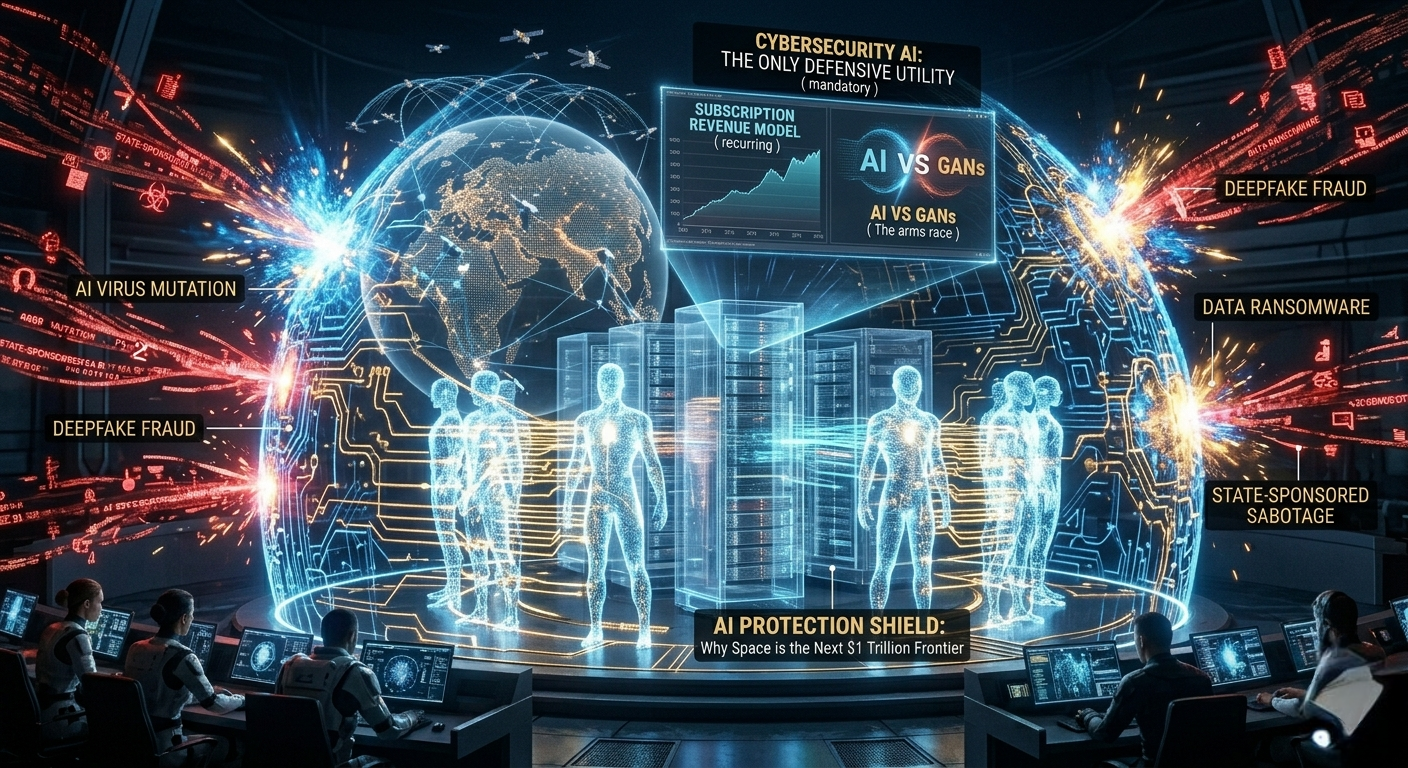
The End of Privacy: Why Cybersecurity AI is the Only Defensive Stock You Need in 2026
We used to worry about someone stealing our credit card numbers. In 2026, that feels like a quaint, old-fashioned concern. Today, the threat isn’t just financial theft; it’s the total erosion of digital identity. As Artificial Intelligence has matured, it has handed a “god-mode” toolkit to hackers, state actors, and digital insurgents. Privacy, as we once defined it, is officially dead.
But for the strategic investor, the death of privacy isn’t just a social crisis—it is the birth of the most resilient “Defensive Sector” in history. While the rest of the market fluctuates with interest rates and geopolitical noise, cybersecurity is the only industry where spending is mandatory, not optional. You can delay buying a new car, but a corporation cannot delay defending its data against an autonomous AI virus. This is the new reality of the digital arms race.
1. The Rise of the “Ghost in the Machine”
In 2026, cyber-attacks are no longer executed by humans sitting in dark rooms. They are launched by Generative Adversarial Networks (GANs) that can test millions of entry points per second. These AI-driven attacks learn from their failures. If a firewall blocks them once, the AI mutates the code and tries again instantly. It’s evolution on steroids.
This “Ghost in the Machine” has rendered traditional, signature-based security obsolete. If your defense system is looking for “known threats,” it’s already lost. The only way to fight an AI is with a more powerful AI. This fundamental shift has forced every Fortune 500 company to migrate their entire security budget toward Autonomous Threat Detection. As an investor, you need to follow that money.
The Titan Strategy: Moving Beyond Growth
In the past, cybersecurity was seen as a “Tech Growth” play. In 2026, it has transitioned into a Defensive Utility. Much like people must pay for water and electricity, modern enterprises must pay for AI-security just to keep the lights on. It is the ultimate hedge against global instability.
2. Deepfakes and the War on Truth
The most terrifying frontier of 2026 isn’t a data breach—it’s the weaponization of reality. AI-generated Deepfakes have become so sophisticated that a CEO can “call” their CFO and authorize a billion-dollar wire transfer with a voice and face that are indistinguishable from the real thing. This isn’t a hypothetical scenario; it is happening monthly.
Companies specializing in Identity Verification and Biometric Cryptography are the new gatekeepers. We are moving toward a “Zero Trust” architecture where nothing—not a voice, not a video, not even a physical presence—is accepted without cryptographic proof. The companies providing this proof are sitting on a gold mine. They are the digital locksmiths of a world where everyone is trying to pick the lock.
3. The Geopolitical Weapon: State-Sponsored Sabotage
As we’ve seen in the recent USA-Iran tensions and other global flashpoints, the first shot in a modern war isn’t a missile; it’s a line of code. Cyber-warfare has become the preferred tool for destabilizing nations without the messiness of a boots-on-the-ground invasion.
Infrastructure—power grids, water filtration systems, and satellite networks—is the new battlefield. In 2026, government contracts for cybersecurity have ballooned to record highs. Companies like Palo Alto Networks, CrowdStrike, and specialized AI-security firms are essentially the new “Defense Contractors.” If you want to invest in the military-industrial complex of the future, you don’t look at tanks; you look at firewalls.
4. The “Cybersecurity Dividend”: Why These Stocks are Resilient
Why do I call these the “only defensive stocks” you need? It comes down to the Subscription Revenue Model. Unlike hardware or retail, cybersecurity firms operate on “sticky” recurring revenue. Once a company integrates an AI-security layer into its cloud infrastructure, the “switching cost” is enormous. It is incredibly difficult to rip out and replace.
Even in a recession, a company might cut its marketing budget or freeze hiring, but it will never cancel its security subscription. To do so is to invite immediate bankruptcy via data ransom. This makes the cash flow of these companies incredibly predictable—a rare gem in the volatile market of 2026.
Conclusion: The Only Way is Forward
We are never going back to a world of simple passwords and private conversations. The genie is out of the bottle. AI has made the world faster, smarter, and infinitely more dangerous. Privacy is the sacrifice we’ve made for progress.
But for you, the investor, the path is clear. You can lament the loss of privacy, or you can invest in the shield that protects what’s left of it. In a world of total digital exposure, the companies that provide the “Armor” are the ones that will define the financial winners of the decade. The “defensive” play of 2026 isn’t gold or bonds—it’s the AI that guards the gates.

Faiz Malik is the founder of Moneydigitals, where he simplifies stock market, crypto, and global investing for beginners. His mission is to help people build wealth smartly with practical insights and real-world strategies.