
War Drums in the Middle East: What Happens to Your Portfolio if the First Shot is Fired?
Politics is noisy, but the market is cold. Right now, the tension between the US and Iran isn’t just a “Middle East problem”—it’s a massive variable for anyone holding a brokerage account. If you’ve been watching the news, you’ve seen the headlines. But if you’re watching the charts, you’re seeing something else: Fear being priced in.
Let’s skip the diplomatic fluff. If we see a direct kinetic conflict between Washington and Tehran tomorrow, the global economy won’t just “dip.” It will undergo a violent recalibration. Here is the ground reality of what actually happens when the world’s biggest military faces off against the gatekeeper of the world’s oil.
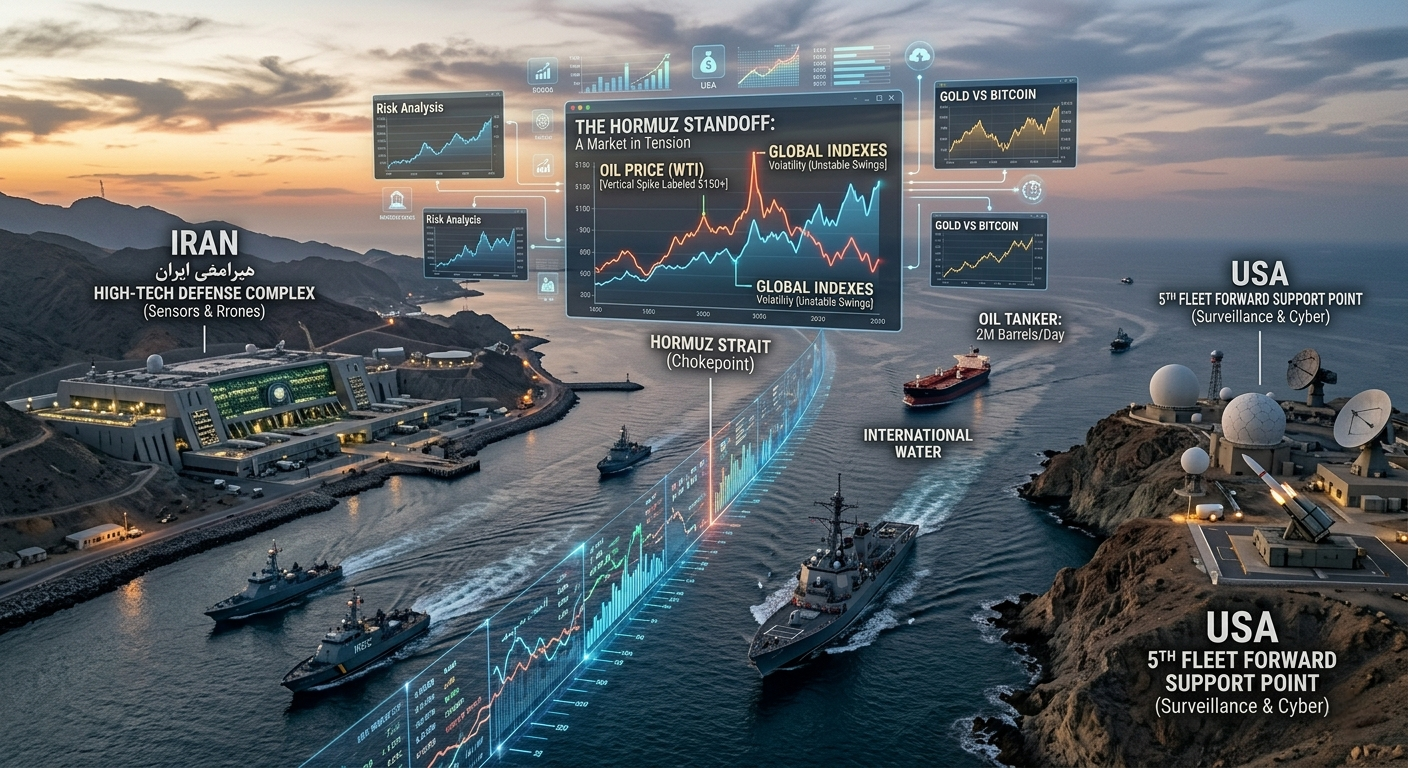
The “Chokepoint” Reality: $150 Oil?
The Strait of Hormuz is the world’s jugular vein. Iran knows this. If the US pushes too hard, Tehran doesn’t need to win a traditional war; they just need to park a few tankers in the wrong place or deploy a few mines.
Every major desk at Goldman and JPMorgan is staring at the same math. If the Strait closes, even for a week, 20% of the world’s oil goes “poof.” We aren’t talking about a slow rise in gas prices. We are talking about a vertical spike. For the stock market, this is a massive tax on every company that ships goods, flies planes, or builds houses. High energy prices are the ultimate “recession starter.”
The Sector Split: Winners and Losers
When the first drone hits a target, the market splits into two worlds. On one side, you have the Defense Titans. Companies like Lockheed Martin, Northrop Grumman, and Raytheon don’t just survive during war—they are the engines of it. Their order books swell, and their stock prices often decouple from the rest of the struggling S&P 500.
On the flip side, Consumer Tech and Retail get crushed. Why? Because when people are worried about a global war and $5-a-gallon gas, they aren’t buying the latest iPhone or upgrading their wardrobe. They are hunkering down. If you’re heavy on growth stocks, a US-Iran conflict is your biggest “Sell” signal.
Gold vs. Bitcoin: The Modern Safe Haven
This is where it gets interesting for 2026. Historically, Gold is the “End of the World” insurance policy. It’s physical, it’s old, and it works. But this time, we have Bitcoin. The “Digital Gold” crowd argues that BTC is the ultimate borderless asset.
However, the reality is usually messier. In the first 48 hours of a major war, everything liquid usually gets sold for cash. People panic. Only after the initial “blood in the streets” do we see the flight to Gold and (potentially) Bitcoin. If you’re a HODLer, you need to have a stomach made of iron for that initial 10-20% drop.
The Political Angle: Rhetoric vs. Reality
Bigger political voices are divided. Washington is playing a dangerous game of “Chicken.” Hardliners want to project strength, but the White House knows that a war in an election-adjacent cycle is economic suicide. Meanwhile, Tehran is using its proxies to test the limits.
The “Smart Money” isn’t betting on a full-scale invasion—that’s too expensive. They are betting on Cyber-warfare and Targeted Strikes. This means the next war won’t just be fought with missiles; it will be fought against banking systems and power grids. Cybersecurity stocks are no longer a “luxury” for your portfolio; they are a necessity.
The Bottom Line: You don’t need to be a general to be a good investor. You just need to realize that the market hates uncertainty more than it hates bad news. If the USA and Iran don’t find a diplomatic exit ramp soon, the “volatility” we’ve seen lately will look like a calm day at the beach.

Faiz Malik is the founder of Moneydigitals, where he simplifies stock market, crypto, and global investing for beginners. His mission is to help people build wealth smartly with practical insights and real-world strategies.