
The AI Gold Rush: Moving Beyond NVIDIA to Find the Silent Winners of 2026
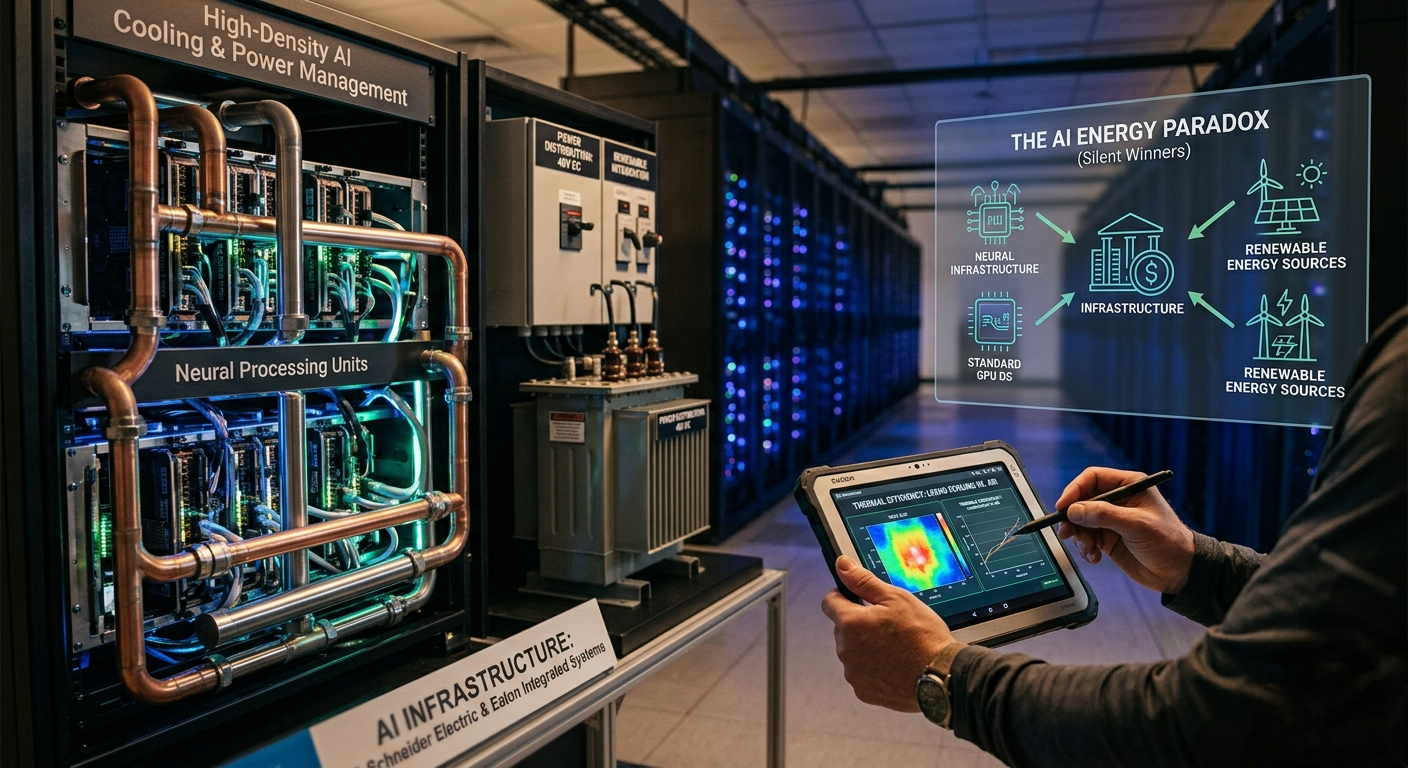
To understand where the real money is moving, you have to look at what AI *eats*. It eats electricity, it requires massive cooling, and it needs a place to live (data centers). While the world is obsessed with chatbots, the institutional titans are quietly buying up the power companies and hardware giants that keep the lights on.
1. The Power Paradox: Why AI is an Energy Play
Every time you ask an AI a question, it consumes nearly ten times more electricity than a standard Google search. As millions of people integrate AI into their daily work, the global demand for power is skyrocketing. This is the first “silent sector” of the AI revolution.
Smart investors are looking at Grid Modernization. Companies like Eaton or Schneider Electric aren’t tech companies in the traditional sense, but without their electrical components, no AI data center can function. By 2026, the bottleneck for AI isn’t just “smarter code”—it’s the physical ability to plug the machines into the wall.
2. The “Real Estate” of the Digital Brain
AI doesn’t exist in the “cloud”—it exists in massive, noisy buildings filled with servers. These are Data Centers. However, regular real estate is struggling, while Data Center REITS (Real Estate Investment Trusts) are thriving.
Large firms like Equinix and Digital Realty are the landlords of the AI era. They provide the physical security, the massive cooling systems (because AI chips get incredibly hot), and the high-speed fiber connections. If NVIDIA provides the brain, these companies provide the skull and the oxygen.
3. Beyond Software: The Edge Computing Shift
In 2026, we are seeing a shift from “Centralized AI” to “Edge AI.” This means your phone, your car, and your kitchen appliances will have AI built directly into their hardware, rather than sending data back to a giant server in another country.
This creates a massive opportunity in Sensors and Semiconductors beyond GPUs. Companies involved in low-power chips and high-speed connectivity (like 5G/6G) are becoming the new favorites for those who want long-term growth without the extreme volatility of pure-play AI stocks.
The Silent AI Winners Checklist
If you are analyzing a company to see if it’s a true AI beneficiary, look for these three traits:
| Sector | Why it Wins? | Key Metric to Watch |
|---|---|---|
| Energy & Utilities | AI requires 24/7 massive power loads. | Grid capacity and renewable integration. |
| Thermal Management | AI chips generate extreme heat. | Liquid cooling technology adoption. |
| Cybersecurity | AI-generated attacks require AI defense. | Subscription growth in AI-security tools. |
4. The Human Element: Don’t Let FOMO Win
The biggest risk in AI investing isn’t technology failing; it’s human psychology. “FOMO” (Fear of Missing Out) drives people to buy at the top. The strategy used by the pros—the “Titan” mindset—is to look for Reasonable Valuation. If a company’s stock price is growing 10x faster than its actual profit, it’s a red flag.
Instead of chasing the “hottest” stock on Twitter, look for the boring companies with solid balance sheets that are slowly integrating AI to save costs. These are the companies that will still be standing in 2030.
Final Strategy for the Modern Investor
- DCA is Still King: Don’t dump your life savings on a single Tuesday. Spread it out.
- Sector Diversification: Own the chips (NVIDIA/AMD), but also own the power (Utilities) and the space (REITs).
- Watch the Capex: Follow the money. When big companies like Microsoft and Amazon report their “Capital Expenditure,” see where they are spending. If they are buying more transformers and cooling fans, that’s where you should look.

Faiz Malik is the founder of Moneydigitals, where he simplifies stock market, crypto, and global investing for beginners. His mission is to help people build wealth smartly with practical insights and real-world strategies.