
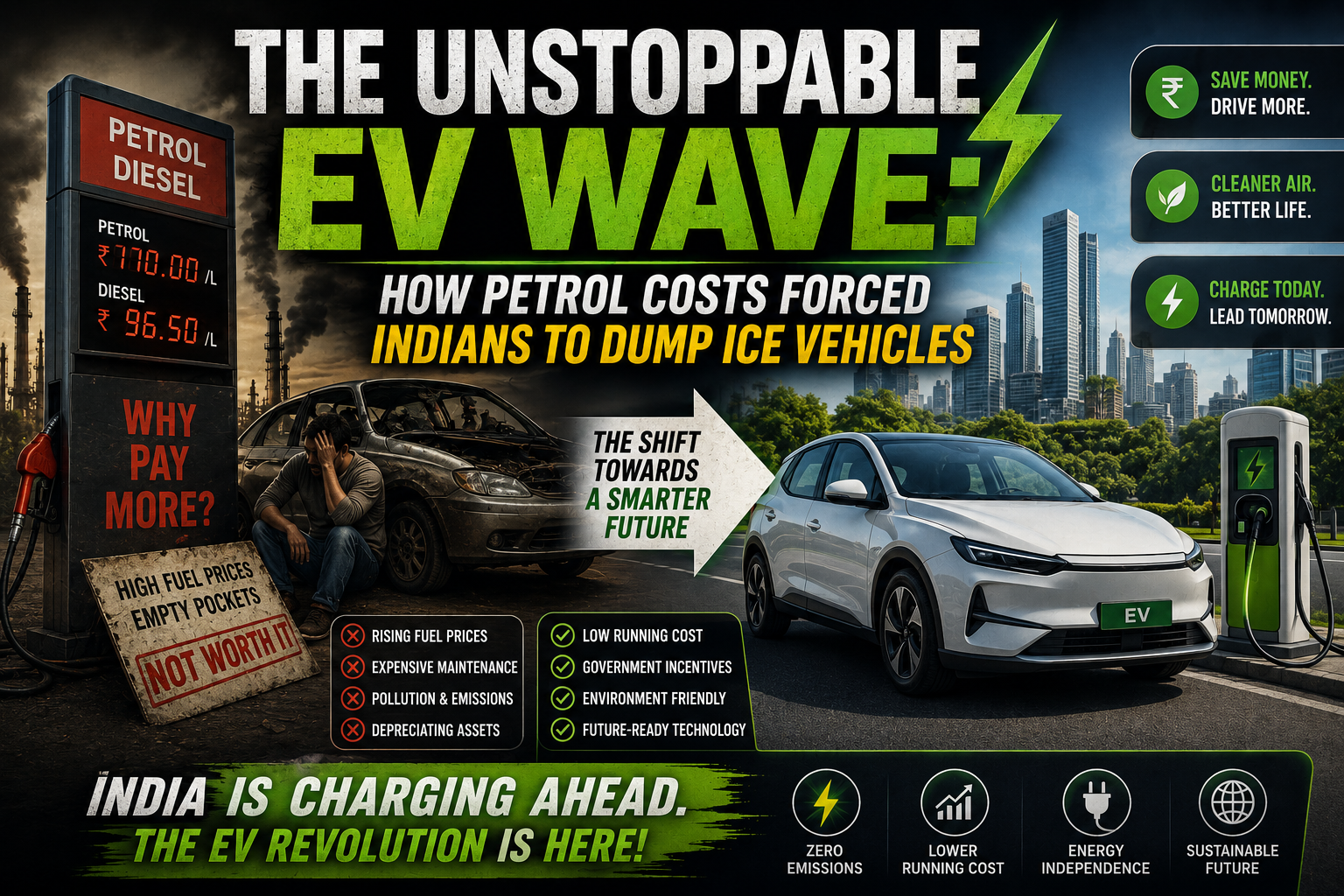
The Unstoppable EV Wave: How Petrol Costs Forced Indians to Dump ICE Vehicles
Let’s be honest for a second. The massive electric shift India is experiencing right now isn’t purely because people want to save the polar ice caps. The real reason is much closer to our wallets. The real reason is much closer to our wallets. When petrol prices comfortably sit past the Rs. 100 mark month after month, running a standard petrol vehicle starts feeling like maintaining a high-maintenance pet. Every trip to the fuel pump leaves a dent in your monthly savings.
This brutal fuel inflation has triggered one of the biggest consumer migrations in the history of the Indian automotive market. People are quietly but rapidly dumping internal combustion engine (ICE) vehicles and moving towards electric options. It isn’t just a fancy urban trend anymore; it is a full-blown financial survival tactic.
The Core Math: How Many Millions are Snapping Up EVs?
If you think the ongoing electric shift India is witnessing is just marketing hype, the latest retail registration numbers from FADA will blow your mind. If you think the electric vehicle boom is just hype, the latest retail registration numbers from FADA will blow your mind. In the latest fiscal year, India’s electric vehicle sales hit a jaw-dropping record of 24.52 lakh (2.45 million) units. That is a massive 25% jump compared to the previous year.
Right now, EV penetration in India has climbed to 8.5% of all new vehicle registrations. If we break this down into categories, you can see exactly where the mass migration is happening:
- The Two-Wheeler Explosion: Electric scooters are leading the charge. Over 14.02 lakh electric two-wheelers were sold this past year alone, grabbing a dominant 57% share of the entire EV market.
- The Four-Wheeler Surge: Electric cars are witnessing absolute madness with an 84% year-on-year growth rate. Total electric car sales in the country shot past the 1.99 lakh mark as families realized they couldn’t afford the daily running costs of mid-sized petrol SUVs anymore.
The Corporate Balance Sheets: Who is Printing Money and Who is Bleeding?
This structural shift has created an immediate war zone among car and bike manufacturers in India. The profits and losses are completely split down the middle.
The Winners (Massive Profit Spikes)
The companies that placed their bets on batteries early on are laughing all the way to the bank. Tata Motors is the undisputed king of the electric car space. Even with fierce competition rolling in, Tata managed to sell nearly 86,000 electric cars, locking down a solid 39% market share. Meanwhile, Mahindra & Mahindra saw a spectacular 407% growth in its green portfolio, selling over 42,000 units on the back of its aggressive new EV models. JSW MG Motor is another massive winner, with their Windsor EV absolutely disrupting the mid-range segment.
In the scooter segment, traditional legacy players like TVS, Bajaj, and Hero MotoCorp completely flexed their muscles. They used their massive dealership networks to capture 61% of the entire electric scooter market, squeezing out older EV startups.
The Losers (The Petrol/Diesel Burn)
On the other side of the fence, pure-play petrol and diesel manufacturing lines are starting to sweat. Companies that were slow to pivot to electric powertrains are watching their traditional showroom footfalls cool down. While overall commercial and passenger car markets are still large, purely conventional petrol hatchbacks and sedans have seen a noticeable 10% to 14% drop in sales growth. Managing massive factory floors for engines that people are increasingly avoiding is turning into a corporate headache.
Why Should You Actually Buy an EV? (The Good Stuff)
If you are standing in a showroom trying to decide between a petrol vehicle and an electric one, here are the real-world operational advantages:
- Microscopic Running Costs: This is the ultimate deal-breaker. Running a standard petrol scooter costs you around Rs. 2.50 to Rs. 3.00 per kilometer. Charging an electric scooter at home costs roughly Rs. 0.25 to Rs. 0.40 per kilometer. The math speaks for itself.
- Mechanical Simplicity: A traditional petrol car has over 2,000 moving parts—pistons, spark plugs, oil filters, gearboxes, and fuel pumps. An EV has about 20. There is no engine oil to change, no complex transmission to service, and very little that can mechanically break down over time.
- Instant Thrill: Electric motors give you 100% of their torque the exact millisecond you step on the gas. There is no engine revving, no gear shifting, and zero vibration. It just shoots forward like a rocket.
The Dark Side: Why EVs Can Be a Total Nightmare (The Bad Stuff)
Don’t let the shiny brochures fool you; owning an EV in India right now comes with some heavy baggage.
- The Massive Upfront Premium: Buying an EV is expensive at the start. Because we import almost all our lithium-ion battery cells, an electric vehicle can cost anywhere from 20% to 40% more than its exact petrol equivalent.
- The Infrastructure Trap: Yes, India has scaled up to over 27,000 public charging stations. But if you take your electric car out on a long-distance interstate highway, finding a DC fast charger that actually works and isn’t blocked by another car is still a stressful gamble.
- The Range Anxiety Disease: Constantly staring at your battery percentage and calculating if you will make it home before the vehicle dies is a real psychological strain for long trips.
- The Resale Time Bomb: EV batteries degrade over a 5 to 8-year cycle. Replacing a dead battery pack out of warranty can cost up to 40% of the car’s original price. This completely tanks the resale value of a used EV in the open market.
The No-Nonsense Buying Guide: Best Options in 2026
Don’t let the shiny brochures fool you; adapting to this modern electric shift India comes with some heavy lifestyle baggage. If you’ve made up your mind to buy, stop looking at random internet ads. These are the absolute best-performing models on Indian roads right now:
Top Electric Scooters
- Ola S1 Pro (Gen 2): Best for tech lovers and heavy daily commuters. It offers an incredible top speed of 120 km/h and a solid real-world range of 140+ km, though the software can sometimes feel glitchy.
- TVS iQube (or iQube ST): The safest pick for families. It feels exactly like a traditional Honda Activa but runs on a battery. Superb build quality, predictable speed, and zero drama.
- Ather Rizta / 450X: The engineering gold standard. The Rizta is a massive, practical family scooter, while the 450X is for people who love sharp handling, cornering, and premium build metrics.
Top Electric Cars
- Tata Punch EV: The perfect entry-level urban SUV. It has great ground clearance, a commanding driving position, and easily gives a practical city range of 280-300 km.
- MG Windsor EV: The ultimate comfort cruiser. With its unique battery-as-a-service model, you don’t pay for the battery upfront, making it highly affordable. The rear seat space is like an executive lounge.
- Mahindra XEV 9e / BE 6: If you want premium road presence, luxury tech, and enough battery juice to handle long-distance weekend trips without breaking a sweat.
The Ultimate Verdict: Who Should Buy and Who Should Say No?
Go for an EV if: Your daily commute inside the city is between 40 km to 100 km, you have a fixed parking spot at home with a safe plug point for overnight charging, and you plan to keep the vehicle for at least 4 years. The fuel savings will easily wipe out the high purchase price.
Stay far away if: You are a highway warrior who constantly drives long distances across states, you live in an apartment complex where installing a personal charger is a bureaucratic nightmare, or your total monthly running is less than 300 km. In these cases, a standard petrol vehicle or a hybrid is still a far smarter financial move.
Disclaimer: This market analysis is created strictly for educational and informational purposes. The retail automotive statistics, corporate market shares, and sales percentages mentioned here are accurate as per the data recorded on May 20, 2026. Government subsidies (like PM E-DRIVE) and raw battery material pricing change frequently, which can alter these vehicle dynamics

Faiz Malik is the founder of Moneydigitals, where he simplifies stock market, crypto, and global investing for beginners. His mission is to help people build wealth smartly with practical insights and real-world strategies.