
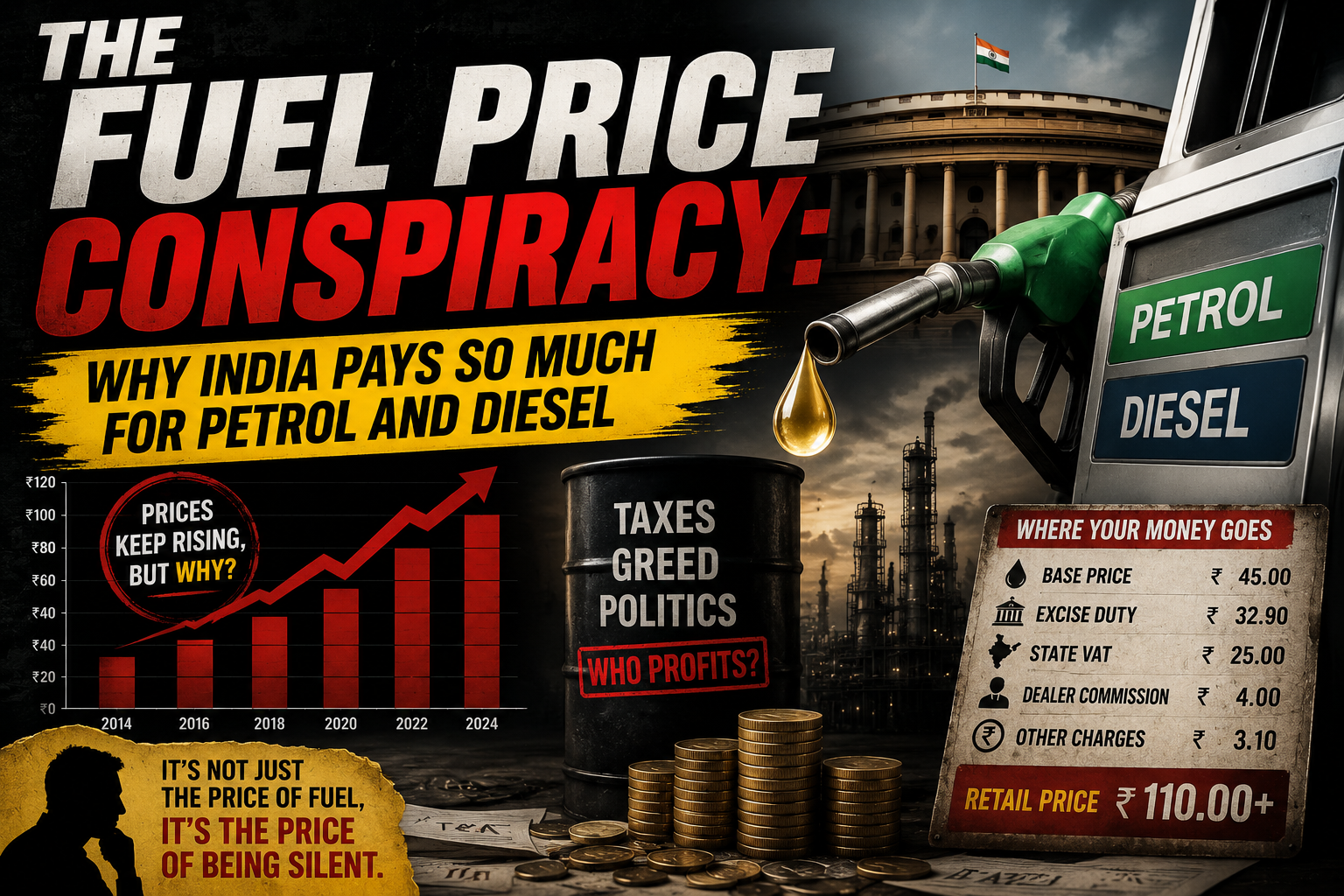
The Fuel Price Conspiracy: Why India Pays So Much for Petrol and Diesel
Every single time you pull your bike or car into a petrol pump, tracking the rising fuel prices in India gives you that instant knot in your stomach. You look at the digital display, watch the numbers fly past Rs. 100 per litre, and wonder where all your hard-earned money is actually going. It is the ultimate middle-class nightmare. What hurts the most is the apparent unfairness of it all—we read headlines about global crude oil markets moving up and down, but the price at our local Indian stations stays stubbornly, painfully high.
The internet is flooded with wild conspiracy theories, half-truths, and political blame games about this. Some blame international oil cartels, others point fingers at corporate greed, and a huge chunk of the population just blames whatever political party is in power. But if you strip away the shouting matches on television debates and look at the actual numbers, the real picture is both fascinating and frustrating.
Let’s do some straight-up math and look at the exact journey of a single litre of fuel—from a black sludge in a foreign ocean to the expensive liquid entering your vehicle’s tank.
The Starting Point: Buying the Raw Black Sludge
Let’s clear up the biggest misconception first: India does not control its own energy destiny. We are forced to import a massive 85% of our entire crude oil requirement from international markets. If the Middle East sneezes, the Indian economy catches a cold. It is that simple.
International oil is traded in barrels (one barrel is roughly 159 litres). Right now, with global shipping routes facing constant geopolitical threats and tensions running high across major trade routes, the Indian basket of crude oil stays quite elevated, hovering around $110 per barrel.
If we translate that into numbers that make sense for our wallets:
- A barrel at $110 translates to roughly Rs. 9,180 in Indian currency.
- Divide that by 159 litres, and the raw cost of that imported oil comes out to about Rs. 58 per litre.
Think about that for a second. Before any Indian government employee opens a tax file, and before any domestic refinery even plugs in a machine, the raw oil floating on a tanker at our ports already costs nearly Rs. 58 per litre. That is our baseline reality.
The Refinery Gate: Cleaning It Up Without Breaking the Bank
Once the crude oil lands at Indian ports, it gets pumped into massive domestic refineries run by companies like Indian Oil Corporation or Reliance. Raw crude is completely useless; it’s a thick, smelly substance that would destroy a standard engine instantly.
Refineries heat this sludge up, separate it into petrol, diesel, and jet fuel, and then transport it across thousands of kilometers to local oil depots. You might think this highly technical process adds a fortune to the final bill, but Indian refineries are shockingly efficient. The actual cost of refining, factory overheads, and freight charges adds just a tiny Rs. 4 to Rs. 6 per litre to the base price.
In fact, to prevent companies from taking advantage of global supply chain chaos, the government keeps a tight leash on these operations, capping refinery margins at around $15 per barrel. So, by the time the fuel is completely processed, pure, and sitting ready at a distribution depot, the actual cost of that petrol is only around Rs. 62 to Rs. 64 per litre.
So how does a Rs. 63 product end up costing Rs. 103 at your local station? Welcome to the tax trap.
The Real Culprit: The Aggressive Tax Double-Whammy
This is where the math goes completely off the rails. The main reason your fuel is so expensive is that both the Central and State governments view petrol and diesel as their personal cash cows.
To keep this massive revenue stream alive, governments have intentionally kept fuel completely outside the scope of GST (Goods and Services Tax). Think about it: if fuel were brought under the absolute maximum GST bracket of 28%, the price of petrol would immediately drop to around Rs. 80 across India. But neither the Centre nor the States want to give up their golden goose. Instead, they hit the product with two independent sets of massive taxes.
Let’s look at the breakdown of taxes on a single litre of petrol:
1. The Central Government’s Flat Cut
The Union government slaps a heavy excise duty on every single litre. They call it by different names—Road Cess, Infrastructure Cess, Agriculture Development Fund—but it all comes out of your pocket. This central tax takes away a flat Rs. 20 to Rs. 21 per litre.
2. The Dealer’s Margin
Next, the petrol pump owner needs their cut to pay for electricity, staff salaries, land leases, and handling losses. This dealer commission adds another Rs. 3.80 to Rs. 4.00 per litre.
3. The State Government’s Percentage Grab
This is why petrol costs Rs. 95 in one city and Rs. 105 in another. State governments charge a percentage-based Value Added Tax (VAT). Because it’s a percentage, every time international oil prices go up, the state’s tax cut automatically increases too.
- Low-tax areas keep it around 19% (adding about Rs. 15).
- High-tax states like Telangana, Andhra Pradesh, or Madhya Pradesh push their VAT past 30%, adding a brutal Rs. 25 to Rs. 30 on every single litre.
When you add Rs. 21 of Central Excise, a Rs. 4 dealer cut, and Rs. 20+ of State VAT onto a Rs. 63 product, you easily cross the dreaded Rs. 100 mark. You are effectively paying more than 50% tax on a basic commodity.
Are the Big Oil Companies Making Billion-Dollar Profits?
It is incredibly easy to look at state-run oil companies like Indian Oil (IOCL), Bharat Petroleum (BPCL), and Hindustan Petroleum (HPCL) and assume they are swimming in cash at the expense of ordinary citizens. But the internal corporate mechanics are surprisingly messy.
The Indian government uses a system of “frozen” retail prices. Even if international crude oil spikes dramatically because of a war or global supply crunch, the government often forces these oil marketing companies to keep retail pump prices completely static for months at a time to keep the public happy and prevent inflation from wrecking the economy.
When crude oil prices jump past $110, these companies actually end up losing money on every single litre of fuel they sell at the pump. Financial reports from major global institutions like Nomura show that these oil marketing companies face immense pressure on their retail marketing margins. To completely break even across all their operations, they technically need a much larger pricing cushion than they currently have. They only survive because they make up for these pump losses through high refining margins and government support for other subsidized products like domestic LPG cylinders.
The Uncomfortable Truth
When you strip away the political noise, the reality of India’s fuel price crisis comes down to a structural trap. We don’t have enough oil under our own soil, which means our entire national budget is permanently at the mercy of global conflicts and the strength of the US Dollar.
More importantly, taxes on petrol and diesel are the easiest way for governments to collect guaranteed revenue. Whether it is the Central government needing thousands of crores to build mega-highways, or State governments requiring instant liquidity to fund local welfare schemes, neither side is willing to blink first and lower their tax rates. Until the day fuel is structurally forced into a uniform GST model, the Indian consumer will just have to accept that starting a vehicle will remain one of the most heavily taxed activities in the country.
Disclaimer: This article is for educational and informational purposes only. The financial calculations, crude oil prices, tax breakdowns, and market data mentioned in this post are based on the economic figures and market trends recorded as of May 19, 2026. Global oil prices and domestic tax structures are subject to change over time, and this content should not be treated as professional financial or investment advice.

Faiz Malik is the founder of Moneydigitals, where he simplifies stock market, crypto, and global investing for beginners. His mission is to help people build wealth smartly with practical insights and real-world strategies.